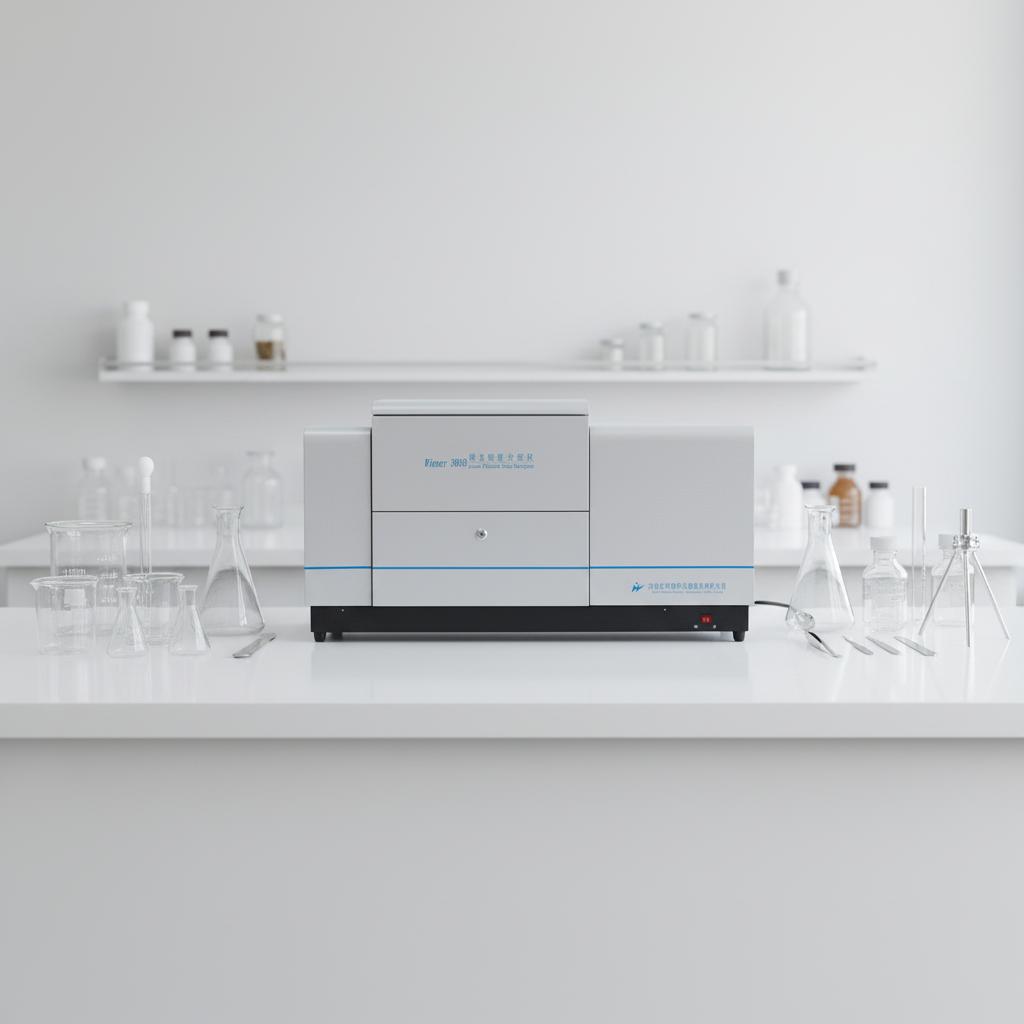
After crushing diamond grains, a powder with a wide size distribution is obtained — from submicron particles to 50–60 μm. To get a W10 fraction (where 99% of grains ≤10 μm), the powder must be separated by size. This is the most labor-intensive and costly production stage, determining the final price and product quality.
Method 1: Air Classification
The main method for W10–W40 fractions. Powder is fed into an air stream inside a centrifugal classifier. Under centrifugal force, coarse grains are thrown to the walls and discharged separately, fine ones are carried by the air stream. By adjusting rotor speed and air flow, powder can be separated into fractions with 1–2 μm precision. Advantages: high throughput, continuous process. Disadvantages: for fractions finer than W5, accuracy decreases.
Method 2: Sedimentation Classification
For fine W0.5–W10 fractions, sedimentation in liquid is used. Powder is diluted with water or alcohol, mixed and left to settle. By Stokes' law, particle settling velocity is proportional to the square of its diameter: coarse ones settle faster. After a set time, the top layer is decanted (only fine particles remain), and the process is repeated. Advantages: very high accuracy for fine fractions, can achieve D90/D10 ≤2. Disadvantages: low throughput, high water consumption, long cycle (several days per fraction).
Method 3: Sieving
For coarse W40 and larger fractions, mechanical sieving through meshes with specific aperture size is used. This is the simplest and cheapest method, but for fractions finer than 40 μm, meshes clog and accuracy drops. In modern production, sieving is only used for preliminary separation into coarse and fine fractions; final classification is done by air or sedimentation methods.
Why Narrow Distribution Costs More
The narrower the distribution (D90/D10 closer to 1), the more material is lost during classification. To get a fraction with D90/D10 ≤2, all particles outside the narrow range must be removed — this can be 30–50% of the original powder. Additionally, narrow distribution requires multiple classification passes (2–4), increasing time and cost. This is why PCD-grade powder with narrow distribution costs 2–3 times more than industrial powder with wide distribution.
When choosing a supplier, always ask for the actual D90/D10 value, not just the nominal W10 fraction. Two powders labeled W10 can have completely different distributions and prices.
Frequently Asked Questions
What is the difference between W-marking and GOST?
W-marking (W40, W20, W5, etc.) indicates average grain size in micrometers (W40 = D50 ≈ 40 μm). GOST 9206-80 grades (ASM 28/20, ASM 10/7, etc.) indicate range through sieves (28/20 means grain passes 28 mesh sieve and stays on 20 mesh sieve). Both systems are used in Russia, we can provide correspondence.
What is more important: D50 or D90?
D50 (median size) characterizes overall grit, while D90 (90th percentile) shows the maximum size of coarse grains. For polishing, D90 max is critical — even a single oversized grain scratches the surface. For grinding, D50 and productivity are more important. We specify both parameters in reports.
Can custom grit sizes be produced?
Yes, we offer custom production of any fraction in the 0.25–60 μm range in 3–7 days. This includes narrow distribution, specified grain shape and special purification. For testing, a trial batch from 1 kg is enough.
Related Articles
Practical tip
For a first purchase we recommend a trial batch from 1 kg: test the fraction on your equipment before a bulk order. Every trial batch comes with a report (particle size, Fe+Ni+Co). Standard W5/W10/W20 fractions are always in stock — ships within 48 hours.
Summary Table of the Three Methods
| Method | Range | Accuracy | Throughput |
|---|---|---|---|
| Air classification | W10–W40 | Medium | High |
| Liquid sedimentation | W0.5–W10 | High | Low |
| Sieving | W40 and coarser | Low | Medium |
In practice production rarely uses one method alone: the coarse part is first sieved, the main mass is then split by air, and fine finishing fractions are refined by sedimentation. Only this combined scheme delivers both throughput and the required distribution sharpness.
Why the Same W10 Can Be Different
The nominal W10 label only sets a target D50. The real distribution depends on how many passes the maker ran and how the classifier is tuned. With one supplier, W10 is a narrow band with D90/D10 ≈ 2 and minimal spread; with another, the same label hides a broad fan from 2 to 25 μm. That is why industry checks the laser report rather than the label. If a report shows only D50, ask for D90 and D10 too — otherwise you do not know what you are paying for.
More Questions on Classification
Why does sedimentation take several days per fraction?
Fine particles settle extremely slowly in liquid; to separate 1 from 2 μm you must hold the layer for a precise time and decant the top very gently. You can only speed it up by sacrificing accuracy. That is why ultra-fine fractions take longer and cost more.
Where do stray coarse grains in a fine fraction come from?
Usually from a worn classifier rotor or a loose duct joint. A single coarse grain in a W5 fraction effectively scrap the whole batch for polishing, which is why a responsible buyer checks D90 on incoming goods.
Conclusion
Particle size classification is where both the quality and the price of micron powder are born. Understanding how air classification differs from sedimentation, and why a narrow fraction inevitably means losses, lets you order exactly the distribution profile your process needs rather than paying for "the letter on the bag."
How Distribution Width Affects Processing Results
A wide distribution means a batch contains both coarse and fine grains at once. Coarse grains cut, fine grains fill gaps and polish — useful for rough grinding where productivity matters. But in finish polishing any coarse grain leaves a scratch that finer grains then remove; when there are too many coarse grains, the process becomes unstable — it scratches one moment, cuts poorly the next. A narrow distribution, in contrast, gives a predictable result but needs more powder and costs more.
How We Control Distribution Between Batches
After each classification, a sample runs on a laser analyzer per ISO 13320:2020. If D50 or D90 fall outside tolerance, the batch is not shipped but returned for rework. For regular customers we keep a value log per fraction so you can see stability from batch to batch. This matters especially once your process is tuned and you cannot afford a "surprise" in the next bag. A sensible policy is to keep two suppliers for one fraction and compare their reports rather than chase the lowest price blindly.
Product inquiry
Fill in 4 fields — we reply within 1 business day. Or message us directly on VK / MAX.
Request a quote