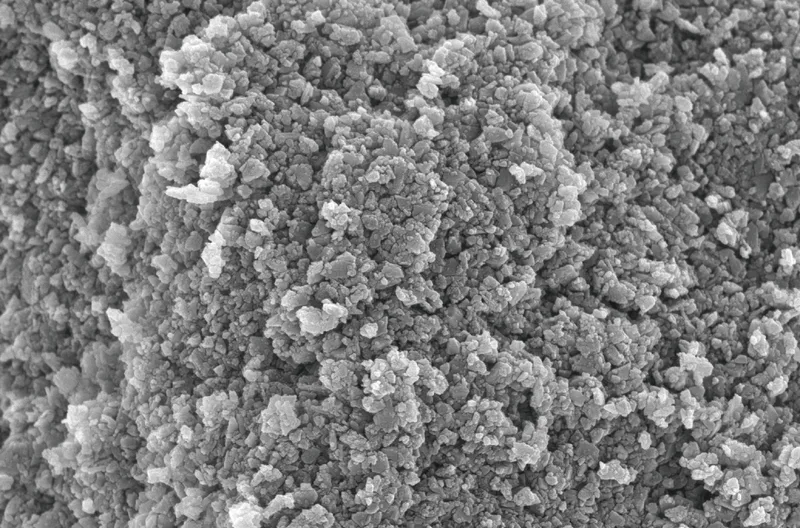
Diamond grain shape is a parameter often overlooked in purchasing, but it directly affects processing results and PCD quality. Spherical and sharp-edged grains behave completely differently during sintering, polishing and sharpening. Choosing the right shape can save up to 30% of processing cost.
Grain Shape Classification
| Class | Shape | Spherical grain ratio | Typical application |
|---|---|---|---|
| AAA | Perfectly spherical | ≥90% | High-quality PCD, precision polishing |
| AA | Spherical | 70–90% | Standard PCD, optics polishing |
| A | Mostly spherical | 50–70% | Tool sharpening, stone processing |
| B | Mixed, sharp-edged | <50% | Rough processing, grinding wheel repair |
Why Shape Affects Bulk Density and Flow
Grain shape determines two technologically important parameters rarely listed in a price sheet. The first is bulk density: rounded grains pack tighter than angular ones, so an equal mass of spherical powder occupies a smaller volume. The second is flow: rounded particles distribute more evenly in a bond during tool making and do not bridge during dosing. Angular grains interlock, form bridges in the hopper and lay unevenly. These two effects — not just the aesthetics of an SEM photo — explain why paying up for rounded shape in PCD and precision tools pays back in process stability, rather than being a marketing surcharge.
Advantages of Spherical Shape
- Uniform packing in PCD sintering: spherical grains pack tightly together, with fewer voids between them. This ensures a uniform PCD structure without defects.
- Predictable polishing: spherical grains work like micro-rollers, providing uniform material removal and a clean scratch-free surface. Ideal for optics and semiconductor polishing.
- Less tool wear: spherical grains cause less damage to grinding wheel bond, increasing its lifespan.
- Result stability: grain shape is consistent from batch to batch, ensuring processing reproducibility.
When Sharp-Edged Grains Are Better
Sharp-edged class B grains have sharp cutting edges that cut material more aggressively. For rough tool sharpening and stone processing, where maximum removal rate is important and surface finish is not critical, sharp-edged grains work more effectively and cost less. However, they are not suitable for finishing and PCD sintering: sharp edges create stresses during sintering and scratches during polishing.
How to Determine Grain Shape
Grain shape is determined by scanning electron microscopy (SEM). A powder sample is applied to carbon tape, coated with a thin layer of gold or platinum for conductivity, and photographed at 1000–10000× magnification. From photos, the spherical grain ratio is determined visually or with software. For PCD-grade, manufacturers provide SEM photos in the quality report.
How to Choose the Shape for Your Task
A simple selection rule: the closer the operation to finishing, and the higher the part value, the rounder the grain you should take. On rough removal, stone cutting and wheel dressing, angular grains win outright on productivity. For intermediate steps a compromise class-A mixed shape is reasonable. For finish polishing, superfinish and PCD sintering you need AAA and AA rounded grains, because the cost of a single scratch or structural defect is many times the powder price difference. If you are unsure which end your process sits at, start with a trial batch from 1 kg: a short trial on your equipment shows whether the chosen shape scratches and gives stable removal faster than any table.
Don't overpay for AAA class if your application is rough sharpening. And conversely: don't save on shape class for PCD — the difference in finished product quality will be greater than the powder savings.
Economically, shape choice boils down to a simple comparison: the price gap between spherical and angular powder is modest, while the cost of an error at the finishing step — a scrapped part, re-polishing, a rejected PCD blank — runs to very different sums. The typical working strategy is a ladder: rougher steps buy cheaper angular series, while each final finishing step takes a small but costly rounded fraction. This layout avoids overpaying where shape does not matter and avoids skimping exactly where it decides. We can build such a multi-fraction set for a specific route from a trial 1 kg batch.
Frequently Asked Questions
How is grain shape determined?
Grain shape is determined by microscopy (optical or electron) and expressed as sphericity coefficient (ratio of grain projection area to circle area of the same perimeter). Coefficient 1.0 = perfect sphere, 0.5 = highly angular grain. PCD-grade micron powder has sphericity coefficient 0.85–0.95 (AAA/AA grade).
Which applications need spherical grain?
Spherical grain is preferred for: PCD sintering (uniform packing), optics polishing (uniform removal, fewer scratches), superfinish (nanometer finish). Angular grain is better for: rough grinding (higher productivity), cutting (aggressive cutting), stone processing (higher speed).
Can spherical and angular grain be blended?
Yes, blending different grain shapes is used to optimize the balance between productivity and surface quality. For example, in stone polishing, a small addition of angular grain increases polishing speed without significantly degrading finish. We can recommend the optimal ratio for a specific process on request.
Related Articles
How Rounded Shape Is Produced
Rounded shape does not emerge by itself after crushing — it is a dedicated step called shaping. The sharp edges of crushed crystals are forced round under controlled conditions, not to a perfect sphere, but enough to remove hazardous sharp tips. This is where the grade difference is built: the tighter the control over rounding and flake share, the higher the class. It also matters not to over-do it: excessive rounding lowers cutting ability, so the technologist balances scratch-free surface against a kept cutting edge. Understanding this helps the buyer not confuse "cheap crushed powder with a few angular grains" with a genuinely shaped product with a SEM-confirmed rounded-grain share.
Practical tip
For a first purchase we recommend a trial batch from 1 kg: test the fraction on your equipment before a bulk order. Every trial batch comes with a report (particle size, Fe+Ni+Co). Standard W5/W10/W20 fractions are always in stock — ships within 48 hours.
Crystal Shape Series Comparison: SCD / SCD-Z / RVD
Diamond micron powder production has three main crystal shapes, each for specific applications:
| Series | Shape | Characteristics | Applications |
|---|---|---|---|
| SCD | Crushed, angular | Full block crystals, sharp edges, no elongated particles | Metal and ceramic bonds, electroplated tools, grinding wheels |
| SCD-Z | Rounded, quasi-spherical | Flowability, narrow distribution, high purity | Precision tools, high-precision grinding wheels |
| RVD | Irregular, crushed | Standard distribution, high brittleness, high removal rate | Economy tools, resin grinding wheels |
For micron powders, additional series include SCMD-WD (super-sharp, for diamond wire) and SCMD-AAA (custom quasi-spherical, for 3D printing and precision manufacturing).
Product inquiry
Fill in 4 fields — we reply within 1 business day. Or message us directly on VK / MAX.
Request a quote