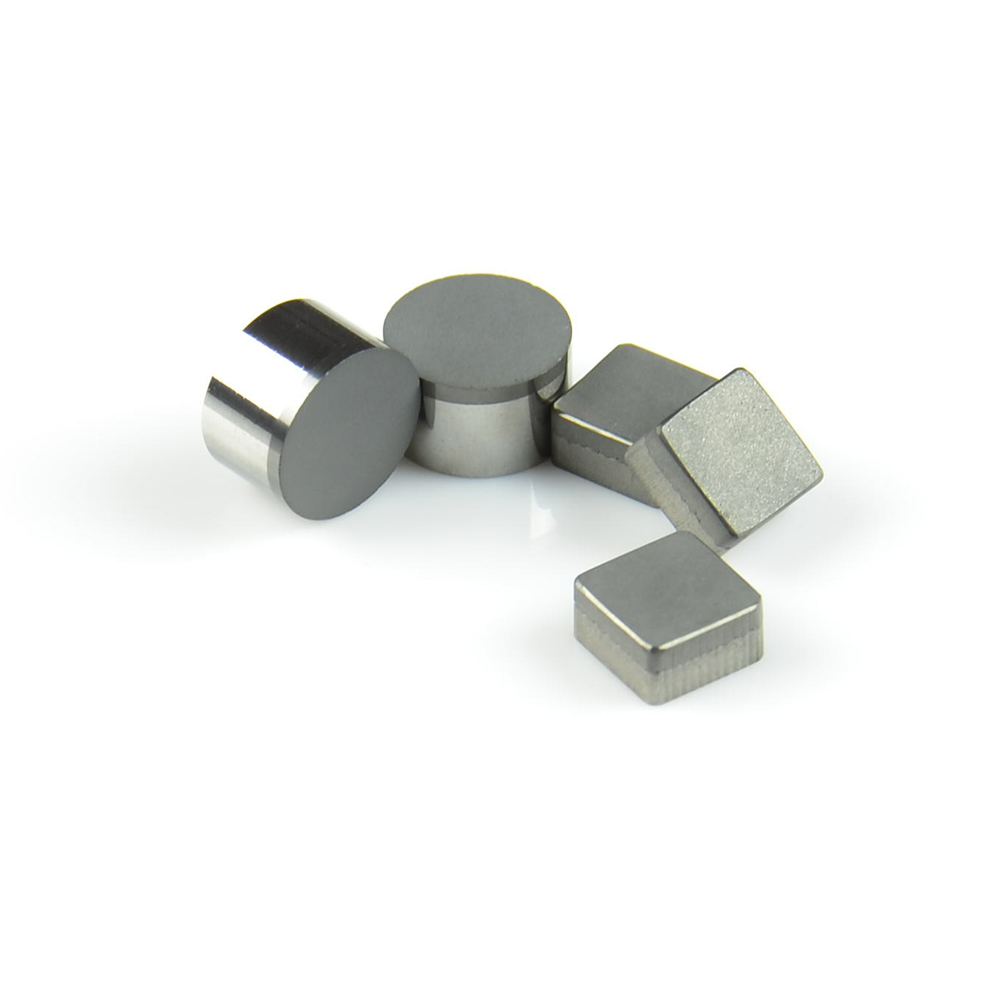
PCD (polycrystalline diamond) and PDC (PCD composite) are materials sintered at ultra-high pressure (5–7 GPa) and temperature (1400–1600°C). The quality of the source diamond powder determines 70% of sintering success. Regular industrial powder for tool sharpening won't work — PCD needs special PCD-grade with tight tolerances on purity, shape and particle size.
PCD Sintering Process: What Happens to the Powder
During PCD sintering, diamond grains undergo extreme stress. First, powder is loaded into a niobium or tantalum capsule, with binder added (cobalt, silicon or silicon carbide). The capsule is then placed in a high-pressure chamber, where over 3–10 minutes pressure rises to 5–7 GPa and temperature to 1400–1600°C. Under these conditions, diamond grains partially dissolve in the binder and recrystallize, forming intergranular bonds — these are what make PCD a monolithic material.
Key Requirement 1: High Purity
At 1400–1600°C, any metallic impurities (Fe, Ni, Co) react with diamond, causing localized graphitization and defect formation. For PCD-grade, total Fe+Ni+Co content must be below 65 ppm. This is 10–20 times purer than regular industrial powder (500–2000 ppm). Such purity is achieved by repeated acid treatment (HCl+HNO3 mixture) and magnetic separation.
Key Requirement 2: Spherical Grain Shape
Spherical grains ensure uniform packing density in the capsule. If grains are sharp-edged, voids form between them that don't fill during sintering and become defects in PCD. Spherical shape also ensures uniform binder distribution between grains. For PCD, AAA and AA class crystals (spherical or near-spherical) are preferred. Sharp-edged class B grains are not recommended for PCD, although they work for tool sharpening.
Key Requirement 3: Narrow Particle Size Distribution
For PCD sintering, it is critical that all grains are approximately the same size. If the powder contains coarse grains (D90 > D50 × 3), they create stresses in the material during sintering due to different dissolution rates. Narrow distribution (D90/D10 ≤ 3) ensures simultaneous dissolution and recrystallization of all grains, yielding a uniform PCD structure. Different PCD layers use different fractions: working layer uses finer W5–W10, supporting layer uses W10–W20.
Key Requirement 4: Thermal Stability
At 1400–1600°C, diamond tends to graphitize — transform into graphite, which sharply reduces PCD strength. Powder thermal stability is determined by grain surface purity and absence of crystal lattice defects. PCD-grade powder must retain its structure up to 850°C in air. Low-thermal-stability powder (with surface defects) begins graphitizing at just 600–700°C, leading to weak zones in PCD.
PCD-Grade Requirements Summary
| Parameter | PCD-grade requirement | Regular industrial |
|---|---|---|
| Fe+Ni+Co | ≤ 65 ppm | 500–2000 ppm |
| Magnetic impurities | ≤ 0.1% | 0.5–2% |
| Grain shape | AAA / AA (spherical) | A / B (mixed) |
| D90/D10 | ≤ 3 | 5–10 |
| Thermal stability | ≥ 850°C | 600–750°C |
The price difference between PCD-grade and regular industrial powder is 2–5 times. But trying to save on powder for PCD leads to up to 30–50% scrap during sintering, which is far more expensive.
Frequently Asked Questions
What thermal stability is needed for PCD?
For PCD sintering at 1400–1600 °C and 5–6 GPa, micron powder with thermal stability of at least 850 °C is required. Grains with lower thermal stability begin to oxidize and graphitize during sintering, reducing PCD strength.
Why is grain sphericity important?
Spherical (or near-spherical) grains ensure uniform packing in the PCD matrix and uniform distribution of binder (Co, Ni). Angular grains create local stresses and pores, reducing PCD strength and wear resistance.
Can grit sizes be blended for PCD?
Yes, bimodal and trimodal distributions (mixing coarse and fine fractions) are often used to increase PCD packing density. The optimal ratio is determined experimentally for the specific sintering process. Testing starts from a trial batch.
Related Articles
Pre-purchase checklist for PCD grade
- Start with a trial batch from 1 kg — the minimum order, with a batch report.
- Confirm crystal shape: cubo-octahedron (AAA) is preferred for high-temperature sintering.
- Check magnetic impurities — should be below 0.1%.
SCMD-PCD/PDC Specialized Series
For PCD/PDC composite production, a specialized SCMD-PCD/PDC micron powder series has been developed with the following characteristics:
- Crystal shape: quasi-spherical, high flowability, high bulk density
- Strength: high strength and thermal stability, wear resistance
- Purity: ultra-high purity (total impurities <65 ppm)
- Distribution: uniform particle size distribution
Applications: PCD, PDC, oil drilling compacts, wire drawing dies, electroplated tools, ceramic and metal bonded abrasives.
Why Quasi-Spherical Shape is Critical for PCD
During PCD sintering, the micron powder is subjected to high pressure (5–6 GPa) and temperature (1400–1600°C). Quasi-spherical grains:
- Ensure maximum packing density (high bulk density)
- Reduce internal stresses in the composite after sintering
- Improve uniform distribution of the binder (cobalt)
- Increase thermal stability of the finished PCD up to 850°C
Angular grains create stress concentrators, leading to composite cracking during cooling.
The Multi-Layer PDC Structure and the Role of Fractions
A modern PDC composite is not a uniform slab but a two- or three-layer structure. The top working layer, 0.5–1 mm of fine W5–W10, cuts the material directly; below it a W10–W20 transition layer smooths the property gap between the fine layer and the substrate; beneath that is a WC-cobalt carbide substrate giving the blank strength and brazeability. Matching fractions by layer matters more than "the finest fraction everywhere": equally fine powder through the whole thickness only raises cost without gain in the cutting layer.
Incoming Inspection of PCD Powder by the Buyer
Even with a polished report in hand, run a simple incoming check. Compare D50 and D90 to the previous batch: the drift should not exceed 5–10%. Assess bulk density and appearance when the powder is poured, and if possible make a trial compact in a capsule. If the powder is caked, looks uneven or has an odd smell, ask for an explanation before loading the press — not after a wasted sinter cycle.
Two Clarifying Questions on the Binder
Which binder to choose — cobalt, silicon or silicon carbide?
The classic choice is cobalt, which wets diamond best. Si and SiC are chosen when higher thermal stability and less catalytic graphitization are needed. The binder choice determines which surface preparation of the grain is optimal, so align this pair (powder + binder) with us before ordering.
How many trial cycles are needed to stabilize the process?
Usually 3–5 trial sinters with recorded pressure, temperature and time. We suggest keeping a simple table: fraction, coefficient of variation, impurities and good-blank yield. With such a table you find your stable process window over a few batches instead of guessing.
Conclusion
PCD powder requirements are a balanced set across purity, shape, distribution and thermal stability, where every number has a practical meaning. Order not "diamond powder in general" but a specific PCD grade with a per-batch report, and start with a trial batch from 1 kg to verify shape and distribution on your own capsule before a bulk purchase.
Product inquiry
Fill in 4 fields — we reply within 1 business day. Or message us directly on VK / MAX.
Request a quote