PCD (polycrystalline diamond) production imposes special requirements on diamond micron powder. Unlike abrasive tool applications where hardness is mainly important, PCD sintering requires a whole complex of parameters. Deviation in any of them can lead to PCD blank delamination, reduced strength or tool failure in service.
1. Purity (impurity content)
Diamond powder purity is measured as carbon content percentage. PCD requires powder with purity of at least 99.9%. Metal impurities (iron, nickel, cobalt) and non-metals (silicon, oxygen) can react with diamond during high-temperature sintering, causing reverse diamond-to-graphite transition. We control purity at every stage — from raw material to finished product.
2. Particle size distribution
For PCD, not only maximum grain size (W5, W10) is important, but also the particle size distribution shape. The ideal distribution is narrow, with coefficient of variation less than 30%. Wide distribution leads to uneven packing density and pore formation in PCD. We use Malvern Mastersizer laser particle size analyzer to control every batch and provide reports on request.
3. Grain shape
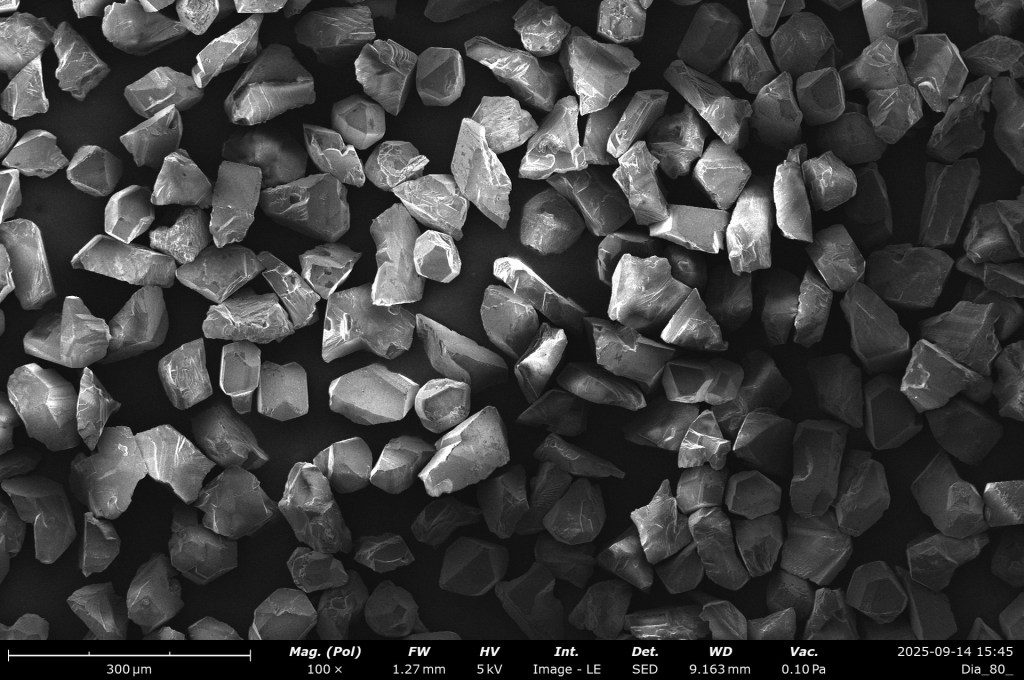
Grain shape affects packing density and PCD strength. For sintering, grains with uniform, near-cubic shape are preferred. Too elongated or needle-like grains worsen packing. We control grain shape using scanning electron microscopy (SEM) and reject batches with deviations.
4. Bond compatibility
In PCD manufacturing, diamond powder is sintered with cobalt binder on WC substrate. Diamond grain surface must be clean and active for good binder wetting. Our powders undergo special surface treatment that improves wetting, ensuring high grain bonding strength in the PCD matrix.
All our PCD batches pass control: purity ≥99.9%, Malvern laser granulometer, SEM morphology. Report included with every batch on request.
Product inquiry
Fill in 4 fields — we reply within 1 business day. Or message us directly on VK / MAX.
Request a quote