At first glance, the difference between 99.9% and 99.99% purity — just 0.09%, seems insignificant. But in diamond micron powder, this difference means 10 times fewer impurities and a price that differs by 2–3 times. For critical applications (PCD sintering, optics polishing, semiconductors), impurities at the 100 ppm level can ruin an entire batch of products.
Where Impurities Come From
Diamond micron powder is not 100% carbon even after thorough purification. Impurities enter the product at all stages of production:
- Synthesis catalyst (Fe/Ni/Co) — the main source of impurities. In HPHT synthesis, graphite turns into diamond in the presence of a metal catalyst (most often a Ni-Fe-Co alloy). Some metal remains embedded in diamond crystals as nanometer-scale inclusions. These inclusions cannot be completely removed — only their concentration can be reduced.
- Graphite heater — synthesis uses a graphite heater that may contain silicon, aluminum, calcium impurities.
- Equipment wear during crushing and classification — steel ball mills and classifiers add iron to the powder.
- Graphite residues (unsynthesized) — after synthesis, some graphite does not turn into diamond and remains in the mixture.
Why Impurities Are Dangerous for Different Applications
1. PCD Sintering
This is the most critical application. During PCD sintering at 1500–2000°C, metal impurities (Fe/Ni/Co) in diamond grains:
- Cause catalytic graphitization of diamond on grain surfaces — diamond turns back into graphite, weakening diamond-to-diamond bonds.
- Create stress zones in the PCD structure due to differences in thermal expansion coefficients, leading to cracks.
- Reduce PCD wear resistance by 2–3 times compared to high-purity powder.
PCD requirement: total Fe+Ni+Co ≤ 65 ppm (standard PCD-grade) or ≤ 30 ppm (high-quality PCD for tools).
2. Optics and Semiconductor Polishing
When polishing optical glass, sapphire, SiC wafers, metal impurities:
- Leave metal inclusions on the polished surface, visible under a microscope and reducing cleanliness class.
- Cause surface staining (yellow/brown spots from iron oxides).
- For semiconductors (SiC, GaN), metal impurities are lethal defects — they create recombination centers and reduce device efficiency.
Optics/semiconductor requirement: total metal impurities ≤ 16 ppm, for critical applications ≤ 5 ppm.
3. General Grinding and Sharpening
For general tasks (steel grinding, tool sharpening, stone processing), impurities are less critical. Fe/Ni/Co content up to 200–500 ppm is acceptable. This is standard industrial powder, 2–3 times cheaper than high-purity.
Diamond Micron Powder Purity Classes
| Class | C content | Fe+Ni+Co | Relative price | Application |
|---|---|---|---|---|
| Standard | ≥ 99.5% | 200–500 ppm | 1× | General grinding, stone, steel |
| Industrial | ≥ 99.9% | 65–200 ppm | 1.5× | Tool sharpening, resin wheels |
| PCD-grade | ≥ 99.95% | ≤ 65 ppm | 2.5× | PCD sintering, metal wheels |
| High-purity | ≥ 99.99% | ≤ 16 ppm | 4× | Optics, ceramic polishing |
| Ultra-high-purity | ≥ 99.995% | ≤ 5 ppm | 6–8× | Semiconductors, critical optics |
How High Purity is Achieved
Diamond micron powder purification is a multi-stage process that can take several days. The higher the required purity, the more stages and the lower the yield of finished product:
- Acid treatment (aqua regia) — a mixture of concentrated nitric and hydrochloric acids (1:3) dissolves metal impurities (Fe, Ni, Co, Cu) on grain surfaces. Treatment at 80–100°C for 4–8 hours. This is the main metal removal method.
- Magnetic separation — a high-gradient magnetic separator removes ferromagnetic particles (iron, nickel, cobalt) from the powder. Powder is passed through a strong magnetic field (10000–20000 Gs), ferromagnetic particles stick to the magnet. High purity requires 2–3 passes.
- Graphite removal (calcination) — graphite residues are oxidized at 500–600°C in air for 2–4 hours. Graphite turns into CO₂ and volatilizes, diamond does not oxidize at this temperature (diamond starts oxidizing at ~700°C).
- Multiple water washing — after each acid treatment, the powder is washed with deionized water to neutral pH (6.5–7.5). High-purity powder requires 10–15 washes.
- Drying in clean environment — final drying at 100–120°C in vacuum or argon atmosphere to avoid recontamination.
Key fact: internal metal inclusions (inside diamond crystals) cannot be removed by any treatment — they were created during synthesis. Therefore, powder purity is primarily determined by the quality of the original synthesized diamond, not by purification. High-purity powder is produced from specially synthesized low-impurity diamond.
How to Verify Purity: ICP Analysis
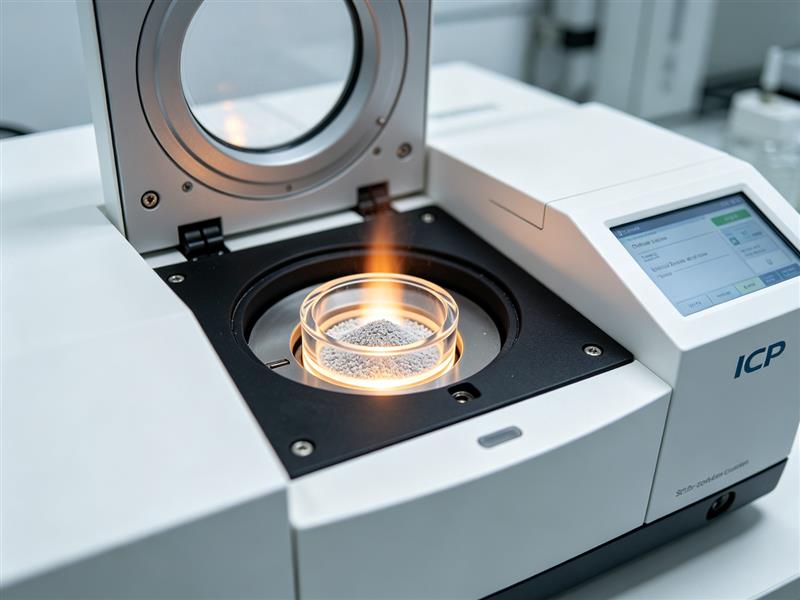
The only reliable way to verify powder purity is ICP-OES or ICP-MS (inductively coupled plasma, optical emission or mass spectrometric detection). This method can determine the concentration of 30+ elements with precision down to 0.1 ppm.
A quality ICP report should contain:
- Concentration of Fe, Ni, Co (main catalytic impurities) — individually and total
- Concentration of Si, Al, Ca, Mg, Ti, Cr, Cu, Zn (secondary impurities)
- Analysis method (ICP-OES or ICP-MS) and detection limit
- Analysis date and batch number
Practical tip: always request an ICP report from the supplier. If a supplier says "purity 99.9%" but cannot provide ICP data — it means they did not measure purity, but state it "by eye". For PCD and optics, require ICP for every batch.
Common Misconceptions About Purity
Myth 1: "99.99% is always better than 99.9%"
This is not always true. For rough grinding of hardened steel or natural stone processing, high-purity powder offers no gain in productivity or tool life, yet costs 4× more. Impurities up to 200 ppm do not affect the chip-removal rate in these operations. Overpaying for ultra-pure powder in non-critical applications is a typical procurement mistake. The right approach: choose a purity class matching the operation, not "the highest available".
Myth 2: "Purity is measured by burning in air"
The old gravimetric method (calcination at 900–1000°C, weighing the residue) only shows the sum of graphite and ash, but does not separate metallic catalyst impurities. The modern acceptance standard is specifically ICP-OES/MS. Some suppliers still state "99.9% purity" based on gravimetry without distinguishing Fe, Ni, and Co individually. Require an element-by-element ICP report, not a single total number.
Myth 3: "White powder = pure"
The visual color of powder depends on residual graphite content (dark gray) and iron oxides (yellow-brown). But nanometer-scale metallic inclusions inside crystals are invisible to the eye and do not affect color. A batch may look snow-white yet contain 80 ppm of nickel in inclusions. Relying on color during acceptance is a serious mistake; decisions are based only on the ICP report.
Quick Purity-Class Selection Table
| Operation type | Recommended class | Fe+Ni+Co, max |
|---|---|---|
| Manual finishing, stone polishing | Standard | 200–500 ppm |
| Cutting-tool sharpening, steel grinding | Industrial | 65–200 ppm |
| PCD and PDC compact sintering | PCD-grade | ≤ 65 ppm |
| Optics, sapphire, ceramic polishing | High-purity | ≤ 16 ppm |
| SiC/GaN wafer polishing, precision electronics | Ultra-high-purity | ≤ 5 ppm |
How Suppliers Fudge Purity Numbers
Three schemes of purity overstatement exist on the market. First: they quote total ash of 0.01% (100 ppm) and call it 99.99%, although metallic catalytic impurities may account for 80 ppm of those 100. Second: they report ICP for Fe alone, omitting Ni and Co, whose sum may be larger. Third: they show the best lab sample but ship from a different batch. The only defense is a COA with batch number, date, and signature for every delivery.
Impurity Control: Method and Limits
Metal impurity content is determined by ICP-OES (inductively coupled plasma optical emission spectrometry): a sample is dissolved and Fe, Ni, Co concentrations are measured down to ppm. Typical acceptance for PCD/PDC is total Fe+Ni+Co ≤ 65 ppm, premium ≤ 30 ppm. Inclusions inside the crystal are captured too, so the result reflects the true purity of the source synthesized diamond, not just surface washing.