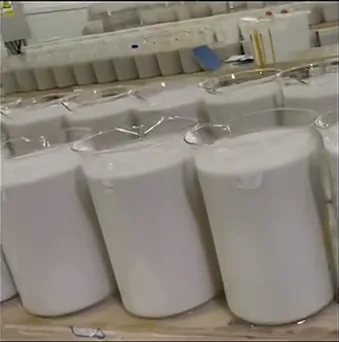
After synthesis and crushing, diamond powder contains a significant amount of impurities: catalyst metals (iron, nickel, cobalt), graphite, silicon and other non-metallic inclusions. For use in polycrystalline diamond (PCD) and high-quality abrasive tools, powder purity must reach 99.9% or above, and total catalyst-metal content must not exceed tens of parts per million. This article describes in detail the multi-stage purification technology used at our industrial cluster in Zhecheng, and explains why purity control at each step directly determines the yield of usable tools.
Why Impurities Are Critical
Diamond is chemically inert and the hardest material, but impurities inherited from synthesis undermine these properties at the micro scale. Catalyst metals (Fe, Ni, Co) act as graphitization centers during high-temperature PCD sintering: the diamond-metal bond fails, and cracks and accelerated-wear zones appear in the structure. Graphite particles reduce cutting ability and leave scratches on the workpiece. Silicate and silicon inclusions are themselves abrasive but have low thermal resistance and fall out under heating, forming voids. This is why semiconductor substrates, ceramics and precision grinding wheels require powder with a verified low residual metal content, not merely "visually clean" powder.
Stage 1: Acid Treatment
The first purification stage removes metallic and carbide impurities by selective dissolution. A mixture of strong acids is used: nitric acid oxidizes and dissolves iron, nickel and cobalt; sulfuric acid intensifies leaching; hydrochloric acid dissolves oxides and carbonates. Silicate inclusions are removed by hydrofluoric acid treatment in dedicated reactors. Diamond is virtually unaffected because it is carbon-based and resistant to oxidation under these conditions. Treatment runs in acid-resistant steel reactors with controlled temperature, acid dosing and stirring, ensuring batch-to-batch reproducibility.
After holding and acid draining, the powder is repeatedly washed with deionized water to neutral pH. pH is monitored potentiometrically in each wash. Insufficient washing leaves residual salts that, on drying, form a film on the grains, worsening wettability and dispersion in downstream operations.
Stage 2: Magnetic Separation
Even after acid treatment, ferromagnetic particles may remain — micro-inclusions of iron and nickel shielded from dissolution by a diamond shell. High-gradient magnetic separation removes them. The powder, as a dilute aqueous suspension, is passed through a matrix with a strong magnetic field gradient; ferro- and paramagnetic particles are captured on the steel matrix, while clean, non-magnetic diamond passes through and is collected.
This stage is especially critical for PCD sintering, where even trace metals (below 50 ppm) can trigger local graphitization and weaken the bond. For SCMD-AA grade, magnetic separation runs in two passes with increasing field strength, reliably driving residual iron to levels compatible with polycrystal pressing requirements.
Stage 3: Water Washing, De-sludging and Flotation
After magnetic separation, the powder undergoes repeated water washing and classification by sedimentation, during which fine sludge is removed while target fractions settle at a defined fall velocity. Flotation removes graphite: graphite wets differently from diamond, so with a frother it attaches to air bubbles and reports to the froth product, while diamond stays in the underflow.
Final washing uses deionized water with conductivity control. For grades destined for semiconductor use, wash-water conductivity must not exceed 5 μS/cm; a higher value indicates residual salt ions and calls for additional washing.
Stage 4: Drying, Sieving and Quality Control
Purified powder is dried in a vacuum oven at 120–150 °C, preventing oxidation and caking. After drying it is de-agglomerated and sieved through nylon screens (non-metallic tooling) to remove agglomerates and avoid iron contamination from steel mesh. Each batch undergoes incoming control: a laser granulometer per ISO 13320:2020 determines D10, D50, D90; ICP spectrometry quantifies residual Fe, Ni, Co; SEM assesses morphology and visible impurities; Raman spectroscopy confirms the diamond phase. Only a batch passing all controls is labeled and released to stock.
Purity Levels by Grade
| Parameter | SCMD-AA | SCMD-A | Regular industrial |
|---|---|---|---|
| Total Fe+Ni+Co, ppm | 13–16 | 20–40 | 65 and above |
| Graphite, control | flotation + Raman | flotation | visual |
| Wash conductivity, μS/cm | ≤5 | ≤10 | not specified |
| Typical use | PCD, SiC substrates | diamond wheels, pastes | roughing |
FAQ
Below are three questions buyers ask most often when first evaluating purification. Answers are based on shipping practice and the requirements placed on PCD and semiconductor-substrate powder.
Can powder purity be judged visually?
No. The color of diamond powder (grey to black) depends on residual graphite and layer thickness, but does not correlate with Fe/Ni/Co content at the ppm level. The only reliable method is ICP spectrometry with a batch COA. Require a report with concrete figures, not the generic phrase "clean powder".
What happens if you buy cheap, under-purified powder?
It is barely noticeable on roughing, but on finishing and during PCD sintering it shows up as accelerated tool wear, part scratches and local bond graphitization. Replacing failed tools and scrapping finished parts usually costs many times the saving on the initial powder price.
What document confirms purity on shipment?
Each batch ships with a Certificate of Analysis (COA) listing D10/D50/D90 per ISO 13320:2020, residual Fe/Ni/Co by ICP, wash conductivity and grade (SCMD-AA or SCMD-A). Buyers may request an independent lab report, including from the accredited center in Zhecheng or Zhengzhou.
It is important to understand that purification and classification are related but not interchangeable operations. Purification governs the chemical cleanliness of grains, while classification (sedimentation and fraction screening) governs the narrowness of the particle size distribution. A batch can be chemically clean but "dirty" in size distribution, and vice versa; this is why the COA always lists both data blocks separately.
Trend: Why Demand for Ultra-Pure Powder Is Growing
As semiconductor and automotive industries shift to finer fractions (W0.5–W3.5) and larger substrate diameters, the allowable impurity level naturally drops. Rough industrial powder with residual iron above 65 ppm is still acceptable for coarse stone grinding, but becomes unsuitable for chemical-mechanical polishing and PCD tool sintering. This pushes manufacturers to invest in two-stage magnetic separation, analytically pure acids and atomic-emission control at each step. For buyers, the key selection criteria are no longer price per carat, but fraction reproducibility and documented residual metals.
Purchasing Tips for Purified Micron Powder
- Start with a trial batch from 1 kg and verify grade on your process before contracting.
- Demand a COA with ICP figures, not generic wording; specify SCMD-AA grade for PCD and semiconductor uses.
- Standard W5, W10, W20 fractions are in stock and ship in 48 hours; custom classification and coatings take 3–7 days.
- The MOQ of 1 kg lets you start serial validation without excessive inventory.
Need purified micron powder with a COA?
Trial batch from 1 kg, W5/W10/W20 in stock, ships in 48 h.
Request a quote