90% of diamond micron powder buyers make the same mistake: they think "diamond powder is diamond powder" and choose only by price. In reality, two parameters — grain size and grain shape — determine 80% of the processing result. Wrong selection leads to scratches on optics, low grinding efficiency, premature tool wear, and wasted money.
Key principle: there is no "universal" diamond powder. For every task there is an optimal combination of grain size and grain shape.
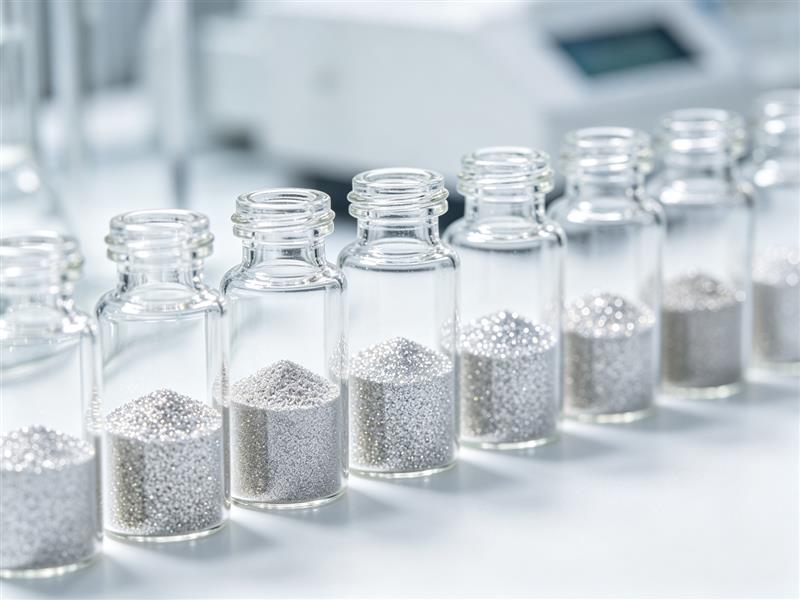
Part 1: Grain Size — The Most Important Parameter
Grain size determines the size of diamond grains and directly affects three characteristics: material removal rate, surface finish, and tool life. Large grains cut faster but leave coarse scratches. Fine grains produce a mirror finish but work slowly.
Grain Size Designation Systems
There are three main designation systems, and confusion between them is a common cause of ordering errors:
- W-system (GOST 9206-80, China GB/T 35477) — W denotes average size in micrometers. W10 = average size 10 μm. Used for micron powders W0.5–W40.
- Mesh system (ISO 8486, FEPA) — number of openings per inch of sieve. 325 mesh = grains passing through a sieve with 325 openings per inch (~45 μm). Used for coarser fractions.
- D-system (laser granulometry) — D50 = median size (50% of grains smaller), D90 = 90% of grains smaller. This is the most accurate characterization of actual distribution.
Grain Size Conversion Table
| W designation | D50 (μm) | Approx. mesh | Main application |
|---|---|---|---|
| W0.5 | 0.5 | — | Final polishing of optics, sapphire |
| W1 | 1.0 | — | Polishing lenses, mirrors, semiconductors |
| W2.5 | 2.5 | — | Precision polishing, lapping |
| W3.5 | 3.5 | — | Polishing carbide, ceramics |
| W5 | 5.0 | 2500 | Fine grinding, pre-polishing |
| W7 | 7.0 | 2000 | Tool grinding, sharpening |
| W10 | 10.0 | 1200 | General grinding, sharpening pastes |
| W14 | 14.0 | 800 | Grinding steel, carbide |
| W20 | 20.0 | 600 | Rough grinding, PCD tools |
| W28 | 28.0 | 500 | Grinding wheels, stone processing |
| W40 | 40.0 | 325 | Rough processing, drilling, cutting |
Part 2: Grain Shape — The Underrated Parameter
If grain size determines "how fine you work," grain shape determines "how you work." Two batches of W10 powder with the same grain size but different grain shapes will give completely different results: one will scratch optics, the other will produce a mirror finish.
Three Main Grain Shapes
- Spherical (isometric, cuboctahedral) — grains of regular rounded shape without sharp edges. Quality classification: AAA (perfect sphere), AA, A, B. Advantages: uniform pressure, no deep scratches, high polishing durability. Disadvantages: lower material removal rate.
- Sharp-edged (irregular, crushed) — grains with sharp cutting edges, obtained by crushing large crystals. Advantages: high removal rate, aggressive grinding. Disadvantages: leave deep scratches, wear out faster, unsuitable for polishing.
- Intermediate (sub-spherical) — slightly rounded grains with blunt edges. Compromise between speed and finish. Suitable for most general grinding tasks.
When to Choose Which Shape
| Application | Recommended shape | Why |
|---|---|---|
| Optics/sapphire polishing | Spherical AAA/AA | No scratches, uniform removal |
| Carbide polishing | Spherical AA/A | Clean surface without chipping |
| PCD sintering | Spherical A/B | Dense packing, diamond-to-diamond bonds |
| Tool sharpening | Intermediate/spherical A | Balance of speed and edge quality |
| Rough grinding | Sharp-edged B | Maximum removal rate |
| Stone/concrete processing | Sharp-edged B/C | Aggressive cutting, low cost |
| Grinding wheels (resin) | Sharp-edged/intermediate B | Cutting ability, bond retention |
Part 3: Common Selection Mistakes
Mistake 1: "The finer, the better"
The most common mistake. Many buyers order W1 for polishing, thinking it will give the best result. In reality, W1 has such a low removal rate that polishing takes 5–10 times longer, and if the surface has coarse scratches from the previous operation, W1 simply cannot remove them. Correct approach: gradually decrease grain size (W20 → W10 → W5 → W2.5 → W1), each step removing scratches from the previous.
Mistake 2: Ignoring grain shape
Most purchase inquiries specify only grain size: "W10 diamond powder." But W10 spherical and W10 sharp-edged are completely different products with different prices and applications. Sharp-edged W10 is 2–3 times cheaper, but it will scratch optics. Always specify grain shape in your order: "W10, spherical, grade AA."
Mistake 3: Mixing grain sizes "to save money"
Some buyers mix W5 and W20, thinking they will get an "average" result. In reality, the large W20 grains will leave deep scratches that the fine W5 cannot remove. The result is worse than pure W5. If you need a compromise, choose an intermediate grain size (W7 or W10), not a mixture.
Part 4: Checklist for Correct Ordering
- ✅ Specify workpiece material (WC-Co carbide, Al₂O₃ ceramic, BK7 optics, sapphire, steel, etc.)
- ✅ Specify operation (rough grinding, precision grinding, lapping, polishing)
- ✅ Specify required surface finish (Ra 0.8, Ra 0.05, mirror, etc.)
- ✅ Specify grain size in W designation (W5, W10, etc.)
- ✅ Specify grain shape (spherical AAA/AA/A/B, sharp-edged, intermediate)
- ✅ Specify required purity (Fe/Ni/Co < 65 ppm for PCD, < 16 ppm for optics)
- ✅ Request a sample of 5–10 carats for testing before a large order
If you are unsure about the selection — describe your task (material, operation, required finish), and a professional supplier will recommend the optimal grain size and shape. This saves time and money.
Final Ordering Checklist
To place an order without errors, specify the following parameters in your inquiry. If any item is unknown — discuss it with the supplier's technical specialist rather than guessing.
- Grit per GOST 9206 (W) or equivalent D50
- Grain shape: sharp (grinding) or spherical (polishing/PCD)
- Purity class (Fe+Ni+Co ppm)
- Application (grinding, polishing, PCD sintering, sharpening)
- Required COA / ICP report per batch
- Packaging (jar, vacuum bag, bucket) and batch size
Common mistake: ordering W14 "so it works for both roughing and finishing". A universal powder delivers neither the productivity nor the surface quality achieved by correctly matching grit to each operation. Better to take two jars of W7 and W28 than one universal one.
How to Read D50, D90 and D10 in the Certificate
In a modern quality certificate, the W marking is replaced by three numbers: D10, D50, and D90. D50 is the median diameter, i.e. 50% of particles are smaller. D90 means 90% are smaller; D10 means 10% are smaller. The D90/D10 ratio characterizes distribution width: the closer to 1, the narrower the fraction and the more stable the process. For PCD sintering it is critical that D90 does not exceed D50 by more than 1.5–2× — otherwise large grains create local stress concentrations.
What to Do If the Process Already Runs But Powder Replacement Is Needed
Never replace powder from one manufacturer with another "head-on". Even at the same D50, morphology and distribution may differ. Order a trial batch of 50–100 g, run comparative tests on your machine at fixed parameters (pressure, speed, feed), measure Ra roughness and productivity. Only when both parameters match should you switch serial production to the new supplier.
Powder Selection Tree
Selection is convenient step by step. Step 1 — define the process (polishing, grinding, cutting, drilling). Step 2 — name the workpiece (glass, ceramic, carbide, stone, rock). Step 3 — set the required roughness or removal rate. Step 4 — pick the grit range from the process table, then refine grain shape (spherical/angular) and strength grade (TI). This order removes confusion between "mesh" and "micron" and directly yields a working D50 range.