Most diamond powder buyers pay attention to grain size, purity, and price. And almost no one asks about TI — Toughness Index (impact compressive strength). And in vain: it is TI that determines how long a diamond tool will last — a drill bit, grinding wheel, or PCD blank. A tool made from diamond with TI 80% will last 2–3 times longer than one made from diamond with TI 50%, at the same grain size and price.
What is TI
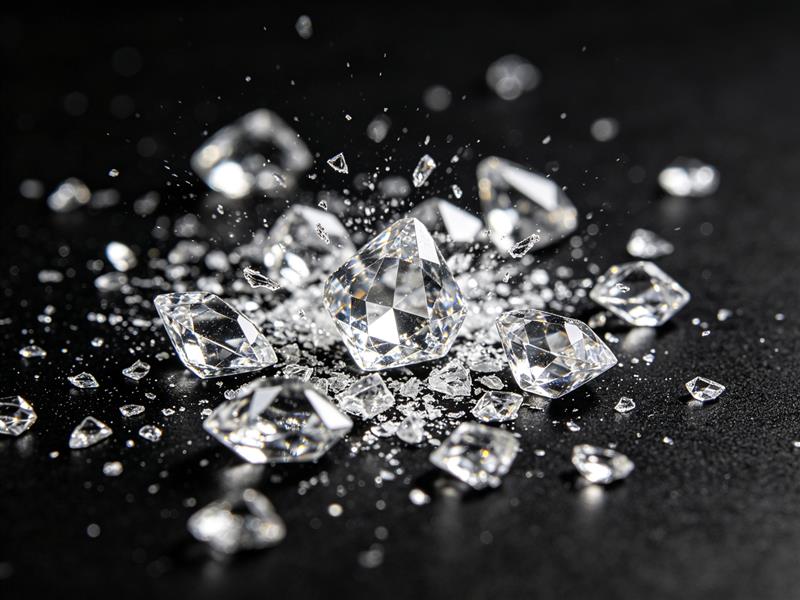
TI (Toughness Index) is a measure of diamond grain strength under impact compression. It measures what percentage of grains do not break after a standard impact. TI = 80% means that after the test, 80% of grains remained intact, while 20% split or cracked.
TI is also called:
- Impact Toughness
- Compressive Strength
- Particle Strength
- In China often referred to as "strength" or "MBD/SMD/RVD" (GOST/GB classification)
How TI is Measured
The standard TI measurement method is described in ASTM B679 (USA) and equivalents GB/T 6408 (China), GOST 9206 (Russia). Test principle:
- Sample preparation: take a sample of diamond grains of standard fraction (e.g., 40/50 mesh), clean and dry.
- Impact: place the sample in a steel cylinder, drop a steel ball of specified weight (usually 1–2 kg) from a fixed height (usually 20–50 cm). Repeat the impact a set number of times (5–10 impacts).
- Sieve analysis: after impact, sieve the sample through a control sieve. Intact grains remain on the sieve, broken ones (finer) pass through.
- TI calculation: TI = (mass of grains remaining on sieve / initial mass) × 100%.
Important: TI is always measured for a specific fraction (grain size). TI for 40/50 mesh and for W10 cannot be compared directly — different test conditions. Always specify the fraction for which TI was measured in the report.
Diamond Classification by TI
| Grade (GOST/GB) | TI, % | Characteristic | Main application |
|---|---|---|---|
| SMD (Super High Strength) | ≥ 85 | Super high strength | Hard rock drilling, heavy cutting |
| MBD (Medium Bond) | 70–85 | High strength | PCD tools, grinding wheels, stone cutting |
| RVD (Resinoid/Vitrified Diamond) | 50–70 | Medium strength | Resin wheels, polishing, general processing |
| Low toughness | < 50 | Low strength, brittle | Fine polishing, lapping (where finish matters, not durability) |
Why TI is Critical for Different Applications
1. PCD (Polycrystalline Diamond)
PCD is made by sintering diamond grains at 5–6 GPa and 1500–2000°C. If grains have low TI, they break during sintering, and the PCD blank ends up with defects (cracks, voids). High TI (≥ 75%) ensures grains survive sintering pressure and temperature, forming a dense structure with diamond-to-diamond bonds. PCD made from low-strength diamond has 2–3 times lower wear resistance.
2. Drill Bits and Roller Cone Bits
When drilling hard rocks (granite, basalt, quartzite), diamond grains experience enormous impact loads. Low-TI grains split after a few minutes of drilling, and the bit "flats out" — loses cutting ability. High-TI grains (SMD, ≥ 85%) survive thousands of impact-load cycles, and bit life is measured in meters of penetration, not centimeters. For soft rock drilling (limestone, chalk), TI is less critical — MBD will do.
3. Grinding Wheels
In a grinding wheel, diamond grains are held by a bond (resin, metal, ceramic). During operation, grains gradually dull, and in a normal process a dulled grain should break out, exposing a new sharp grain underneath. If TI is too high, grains do not break out but "glaze over" — the wheel stops cutting. If TI is too low, grains break out too early — the wheel wears out quickly. Optimal TI for grinding wheels: MBD (70–80%) for metal bond, RVD (50–70%) for resin bond.
4. Polishing and Lapping
For polishing, TI is not the main parameter — grain shape (spherical) and narrow distribution are more important. But too high TI for polishing is also bad: strong grains do not break into fine fragments and may leave scratches. For optics and semiconductor polishing, RVD or low-strength diamond (TI 40–60%) is usually used, which gradually micro-fractures, providing fine removal without scratches.
How to Distinguish High-Strength Diamond from Regular
Unfortunately, TI cannot be determined by appearance (color, shape). Two grains of the same color and shape can have TI 50% and 85%. The only reliable method is to request a TI test report from the supplier. If a supplier cannot provide TI — it's a signal that they are selling low-strength diamond as high-strength.
Indirect signs of high TI:
- Price — high-strength diamond (SMD/MBD) costs 1.5–2 times more than RVD. If someone offers "high-strength" diamond at RVD price — it's a scam.
- Specification classification — MBD/SMD indicate high strength, RVD — medium.
- Supplier reputation — large manufacturers (Henan Huanghe, Zhongnan Diamond, Sino-Crystal Diamond) control TI and provide certificates.
TI vs TTI: the Difference and Why It Matters for Tools
Besides TI (toughness index at room temperature), the industry widely uses TTI (Thermal Toughness Index). The difference is fundamental:
| Parameter | TI | TTI |
|---|---|---|
| Pre-treatment | None | Heat to 1100°C in argon, 15 min |
| What it measures | Strength as-received | Strength after thermal shock |
| Typical ratio | TTI/TI = 0.7–0.9 (higher = more stable under heat) | |
| Application | Grinding wheels, cold machining | PDC, drilling, high-temp cutting |
A low TTI/TI (e.g., 0.5–0.6) means the powder contains many metastable defects that "fire" upon heating. Such material can be used for cold grinding but fails catastrophically during PDC sintering or high-temperature drilling. For PDC, TTI ≥ 50% and TTI/TI ≥ 0.8 are required.
TI Measurement Variability and Why Two Reports May Disagree
TI is not an absolute constant but a statistical estimate that depends on test conditions. The same powder measured in two different labs may show TI 62% and 71%. This is normal. Main sources of error:
- Weight and material of steel balls — acceptable weight spread is ±5%, but impact energy depends on it.
- Height and number of impacts — the standard allows deviations, and different plants use their own settings.
- Sieve analysis after impact — manual or automated sieving, ambient humidity, sieve wear all affect the result.
Practical rule: a 5–8% discrepancy between two labs is considered normal. If the difference exceeds 10%, request a re-test or independent lab verification. For critical contracts (PDC, drilling), it makes sense to specify: "TI measured per ASTM B679, report issued by an ISO/IEC 17025 accredited laboratory."
Relationship Between TI, Crystal Morphology and Synthesis Method
TI is not an "abstract number" but a direct consequence of how and from what the diamond was grown. HPHT crystals grown at higher pressure and with low catalyst content have fewer internal defects and therefore yield higher TI. Conversely, crystals produced at borderline HPHT parameters contain microcracks and inclusions that manifest as low TI. This is why the same "marked" SMD grade from different manufacturers can give TI 75% and 88% — the difference lies in HPHT process stability. When choosing a supplier, it makes sense to check not only the average TI per batch but also the minimum TI across 3–5 randomly sampled aliquots: stability is at least as important as the average.
Practical conclusion: when ordering diamond powder for tools, always specify the required TI (or MBD/SMD/RVD grade). Don't limit yourself to grain size only. A tool made from high-strength diamond pays back its higher price through 2–3 times longer service life.
How TI Is Measured and What It Means for PDC
Toughness Index TI is measured per ASTM B679: a diamond sample is placed in a steel cylinder with steel balls, vibrated for a set time, then the fraction of intact grains is counted under a microscope. TI = percentage of unbroken grains. Higher TI means better resistance to impact and abrasion.
- TI 40–55 — weak diamond, for resin bonds (polishing).
- TI 60–75 — standard for PCD/PDC and metal bonds.
- TI > 80 — premium grade, high impact strength.
TI and PDC Life: The Practical Link
In PDC, higher-TI powder retains more intact grains under impact, extending bit life in hard, abrasive rock. Low-TI powder fragments faster: wear rate rises, but in soft rock it often gives a smoother cut. By origin: HPHT powder typically shows TI 60–80, CVD tends to the upper range but costs more.
TI measurement uncertainty is about ±3–5%, so compare batches tested by the same method and require the test report, not just the claimed value. Batch-to-batch TI stability matters more than a one-off high number.