Diamond is a crystalline modification of carbon, the hardest known natural substance (10 on the Mohs scale). Its cubic crystal lattice: each carbon atom is bonded to four neighbors by a strong covalent bond. This structure explains diamond's unique hardness, thermal conductivity and chemical resistance.
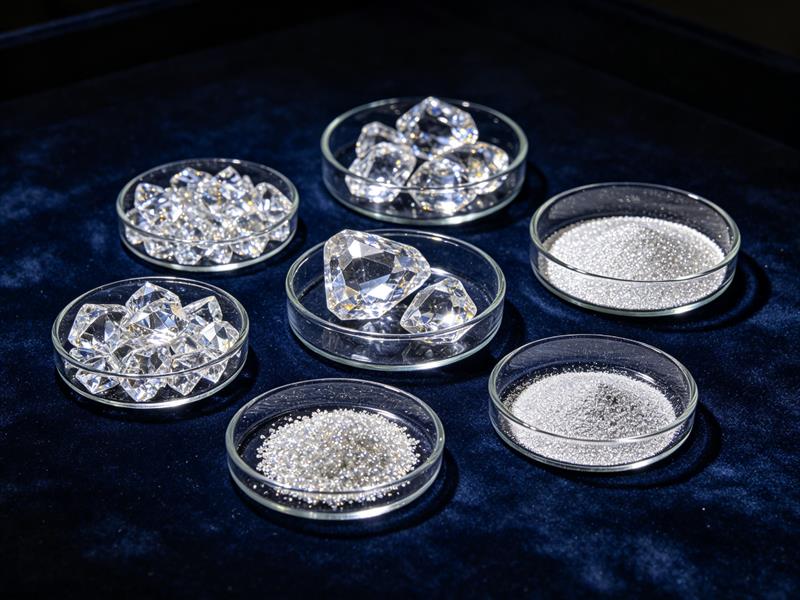
Diamond Classification
1. By Origin
- Natural diamonds — formed in the Earth's mantle at high pressures and temperatures over billions of years, extracted from kimberlite pipes and alluvial deposits.
- Synthetic diamonds — produced industrially (HPHT or CVD), comparable in physicochemical properties to natural diamonds. Account for over 98% of the industrial market.
2. By Purpose
- Industrial — for industrial processing, account for over 95% of world production. Include powders, pastes, suspensions, PCD composites.
- Gem-quality — transparent colorless or colored crystals for cutting and jewelry. Evaluated by 4C: carat, color, clarity, cut.
3. By Grain Size
- Coarse-grained — from 200 μm and larger, for cutting and drilling tool production.
- Fine-grained — 40–200 μm, for grinding wheels and general processing.
- Micron Powders — from 0.5 to 40 μm (designations W0.5, W1, W2.5, W5, W10, W20, W40), used for precision grinding, lapping and polishing. Standards: GOST 9206-80, ISO 13320, GB/T 35477.
4. By Crystal Shape
- Isometric (cuboctahedral) — regular shape, optimal strength and wear resistance. Preferred for PCD sintering and heavy cutting conditions.
- Elongated (platy, needle-like) — for special processing applications where cutting ability of individual faces is important.
- Irregular shape — obtained after crushing, with sharp cutting edges. Used in grinding wheels, pastes and suspensions.
5. By Strength
- High-strength (TI ≥ 80%) — for heavy cutting conditions, hard rock drilling, PCD tools. TI (Toughness Index) — compressive strength indicator.
- Medium strength (TI 60–80%) — universal application, general processing, grinding.
- Low-strength (TI < 60%) — for polishing, fine grinding, lapping, where surface finish matters more than durability.
Synthetic Diamond Production Technology
Method 1: HPHT (High Pressure High Temperature)
The main industrial method, providing about 90% of the world's synthetic diamond volume. Principle: reproducing natural conditions (high pressure and temperature) in a laboratory apparatus with the addition of a metal catalyst that reduces the activation energy of the graphite → diamond phase transition.
Process:
- Charge preparation: graphite (purity ≥ 99.9%) + metal catalyst (Ni, Fe, Co or their alloys) + seed crystal (for growing large crystals).
- Cell assembly: charge in niobium capsule → graphite heater → pyrophyllite matrix.
- Synthesis: pressure 50–60 kbar (5–6 GPa), temperature 1400–1600 °C, time 3–10 minutes (for powder) or 50–100 hours (for large crystals).
- Growth mechanism: catalyst melts → graphite dissolves in melt → supersaturated carbon solution forms → carbon precipitates as diamond on seed or nucleation centers.
- Extraction and purification: cell disassembly → crystal separation → acid treatment (removing metal and graphite) → washing → sorting.
Result: diamond crystals 0.1–3 mm (standard) or up to 10 mm+ (with seed), yellow/yellow-green color (nitrogen impurities), yield 30–60%.
Method 2: CVD (Chemical Vapor Deposition)
A newer method allowing growth of diamond films and large transparent gem-quality crystals. Principle: diamond is deposited on a substrate from a gas mixture (methane + hydrogen) at relatively low pressure and temperature. Hydrogen selectively etches graphite (unstable phase) and promotes diamond growth.
Process:
- Substrate preparation: diamond single crystal (homoepitaxy) or silicon/silicon carbide (heteroepitaxy). Substrate is treated with diamond paste to create nucleation centers.
- Gas mixture: methane (CH₄) 1–5% + hydrogen (H₂) 95–99%. Sometimes nitrogen (growth acceleration) or boron (p-type semiconductor) is added.
- Activation: HFCVD (hot filament 2000–2400 °C), MPCVD (microwave plasma 2.45 GHz), DC Arc Jet (arc discharge).
- Deposition: pressure 0.01–0.1 atm, substrate temperature 700–1000 °C, growth rate 0.1–10 μm/hour (up to 100 μm/hour for Arc Jet).
- Mechanism: methane decomposes into methyl radicals (CH₃·) and atomic hydrogen (H·) → CH₃· adsorbs on surface → H· etches sp² carbon (graphite), leaving sp³ (diamond) → diamond film forms.
CVD advantages: pure colorless gem-quality crystals, large-area films (up to 12 inches), boron/phosphorus doping for electronics, no metallic inclusions.
Diamond Micron Powder Production
Micron Powder is obtained from large diamond crystals through the following technological scheme:
1. Crushing
- Coarse crushing: jaw/cone crushers — from lumps to 1–5 mm.
- Medium crushing: ball mills — from 1–5 mm to 40–100 μm.
- Fine crushing: jet mills — grains accelerated to 300–500 m/s collide with each other, fracturing along cleavage planes. Result: irregular-shaped particles with sharp cutting edges.
2. Purification (Refining)
- Acid treatment: boiling in H₂SO₄ + HNO₃ mixture at 150–200 °C. Metal catalyst → soluble salts; graphite/amorphous carbon → CO₂.
- Washing: with distilled water to neutral reaction (pH = 7).
- Drying: in vacuum oven at 100–120 °C.
- Result: purity ≥ 99.9%.
3. Grain Size Classification
- Sedimentation method (W0.5–W10): particles of different sizes settle in liquid at different speeds (Stokes' law: v = 2·r²·g·(ρ_p-ρ_l)/(9·η)). Sequential decantation of fractions.
- Air classification (W10–W60): in air flow, larger particles settle faster, finer are carried away. Flow speed adjustment for fraction separation.
- Centrifugal classification: in centrifugal field, particles of different sizes follow different trajectories. More precise separation.
4. Quality Control
- Particle size distribution: laser granulometer (ISO 13320), laser diffraction measurement.
- Particle morphology: scanning electron microscope (SEM), shape and sharpness evaluation.
- Purity: chemical analysis (ICP-OES, X-ray fluorescence analysis).
- Strength: single grain compression tests (TI — Toughness Index).
- Magnetic impurities: magnetic susceptibility measurement.
Diamond is a unique material combining maximum hardness, high thermal conductivity and chemical inertness. Understanding classification and production principles allows selecting the optimal diamond type for a specific industrial application.
Interesting Facts
- One carat of diamond = 0.2 grams, but for micron powder the price is per carat, not per kilogram.
- Industrial synthetic diamond was first produced in 1954 by General Electric (USA).
- China produces over 90% of the world's synthetic diamond volume, main center — Henan province (Zhecheng area).
- Diamond conducts heat 5 times better than copper, so it is used in high-temperature electronics.
- The largest synthetic diamond grown by CVD method weighs over 100 carats.
Briefly: How to Choose the Right Class
For grinding and tool sharpening, take sharp grit from monolithic crystals. For PCD sintering and precision polishing, use spherical micron powder from special low-impurity crystals. For electroplated tools, take narrow fractions with high TI. Do not buy "universal" diamond powder: every application has its own morphology and ash content.
Remember a simple rule: the narrower the fraction and the purer the crystal, the more expensive the powder and the more critical the operation it serves. Start the selection from the target Ra and required productivity, not from the "best" available grade.
GOST, ISO and Grain Shape
Traditionally in the CIS, diamond powder grit was described by GOST 9206 (grades AS, ASM, ASN with grit numbers), while internationally by ISO 13320 (D50/D90 laser diffraction). Modern supply increasingly specifies D50, as it better reflects powder behavior. Beyond size, grain shape matters: cubic and intermediate give better packing and strength, acicular and plate-like are worse. So when ordering, state both size and shape class, not just the GOST number.