Diamond is a crystalline modification of carbon in which each atom is connected to four neighbors by strong covalent bonds. This structure makes diamond the hardest known substance. In this article, we will break down diamond production principles from the atomic level to industrial technologies.
1. Atomic Structure of Diamond
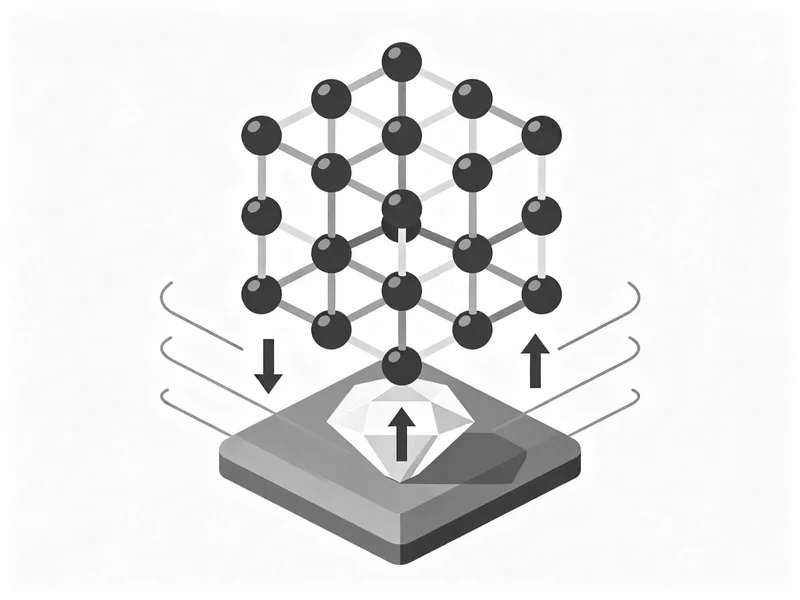
Diamond has a cubic crystal lattice of the "diamond cubic" type. Each carbon atom is at the center of a tetrahedron formed by four neighboring atoms. The distance between atoms is 0.154 nm, the bond angle is 109.5°.
Key structural features:
- sp³ hybridization of carbon atoms — all four valence electrons participate in bond formation
- C-C covalent bonds are very strong (bond energy ~347 kJ/mol)
- No free electrons — diamond is a dielectric
- High atomic packing density — density 3.52 g/cm³
- Anisotropy — properties depend on crystallographic direction
Comparison with graphite: in graphite, carbon atoms have sp² hybridization, forming flat layers with weak interlayer bonds. That's why graphite is soft and conducts electricity, while diamond is the hardest insulator.
2. Natural Diamond Formation
Natural diamonds form in the Earth's mantle at a depth of 150–200 km, where diamond stability conditions exist:
- Pressure: 4.5–6 GPa (45,000–60,000 atmospheres)
- Temperature: 900–1300 °C
- Time: 1–3 billion years
Formation mechanism:
- Carbon enters the mantle as carbonate rocks or organic matter (during subduction of oceanic plates)
- At high pressures and temperatures, carbonates are reduced to elemental carbon
- Carbon crystallizes as diamond (stable phase under these conditions)
- Diamonds are transported to the surface with kimberlite magmas during volcanic eruptions (ascent speed up to 70 km/hour)
- During rapid ascent, diamonds do not have time to transform into graphite (metastable state under normal conditions)
3. HPHT Synthesis Principle
HPHT (High Pressure High Temperature) is the main industrial method for diamond synthesis, reproducing natural conditions in a laboratory apparatus.
Physicochemical Principle
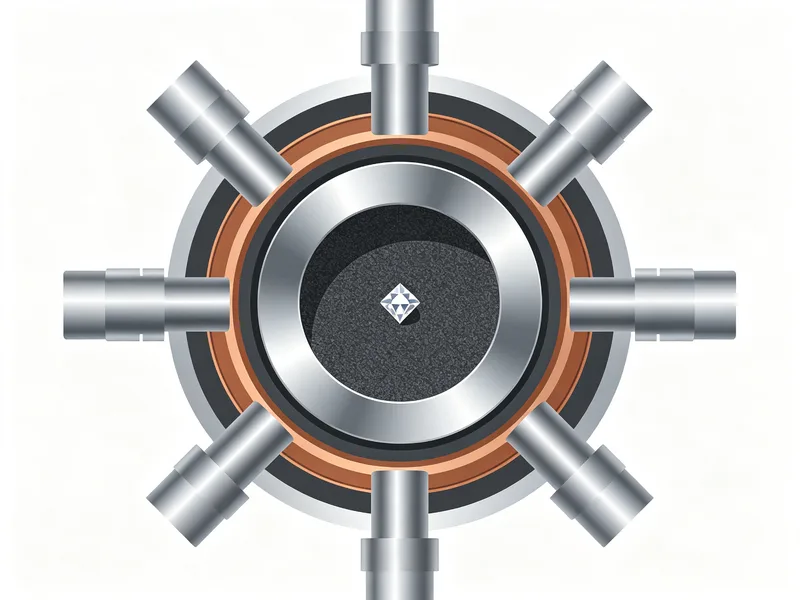
Direct graphite → diamond transition requires very high pressures (>15 GPa) and temperatures (>3000 °C), which is economically impractical. Therefore, a catalytic method with a metallic solvent is used:
- Metallic catalyst (Ni, Fe, Co or their alloys) melts at 1400–1600 °C
- Graphite dissolves in the metal melt, forming a supersaturated carbon solution
- Carbon precipitates as diamond on seed or nucleation centers (diamond is the stable phase at 5–6 GPa)
- Catalyst reduces the activation energy of the phase transition, allowing synthesis to proceed at 5–6 GPa instead of 15+ GPa
Types of HPHT Apparatus
- Belt press: two conical punches compress the assembly in a belt. Pressure up to 10 GPa, volume up to 100 cm³. Used for large crystals.
- Cubic press: six punches compress the assembly from six sides. Pressure up to 6 GPa, volume up to 500 cm³. Main type for mass production of industrial diamond.
- BARS: spherical chamber, pressure up to 10 GPa. Used for growing gem-quality crystals.
4. CVD Deposition Principle
CVD (Chemical Vapor Deposition) is a method of growing diamond from the gas phase at relatively low pressure and temperature. Allows obtaining pure colorless gem-quality crystals and large-area diamond films.
Physicochemical Principle
At normal pressure, diamond is a metastable phase (graphite is more stable). However, CVD allows diamond growth due to selective etching of graphite by atomic hydrogen:
- Gas mixture (methane CH₄ 1–5% + hydrogen H₂ 95–99%) is activated (hot filament, microwave plasma, arc discharge)
- Methane decomposes into methyl radicals (CH₃·) and atomic hydrogen (H·)
- CH₃· adsorbs on the substrate surface and incorporates into the diamond lattice (diamond growth)
- H· selectively etches sp² carbon (graphite), which forms as a side phase, but does not etch sp³ carbon (diamond)
- As a result, a pure diamond phase grows on the surface
Types of CVD Reactors
- HFCVD (Hot Filament CVD): tungsten or tantalum filament heated to 2000–2400 °C. Simple and cheap, but possible metal contamination. Growth rate 0.1–1 μm/hour.
- MPCVD (Microwave Plasma CVD): microwave plasma 2.45 GHz. High purity, uniformity, main method for gem-quality crystals. Growth rate 0.5–10 μm/hour.
- DC Arc Jet CVD: arc discharge between electrodes. Very high growth rate (up to 100 μm/hour), but more difficult to control. Used for thick films.
5. Diamond Micron Powder Production Principle
Diamond micron powder is diamond particles ranging from 0.5 to 60 μm, used for precision grinding, lapping and polishing. Production includes several stages:
Stage 1: Crushing
Large diamond crystals are crushed to the required size. The main method is jet milling:
- Grains are accelerated by compressed air to 300–500 m/s
- Grains collide with each other in the crushing chamber
- Fracture occurs along cleavage planes (diamond is brittle)
- Result: irregular-shaped particles with sharp cutting edges
Stage 2: Purification
After crushing, the powder contains metallic catalyst and graphite impurities. Purification:
- Boiling in H₂SO₄ + HNO₃ mixture at 150–200 °C
- Metallic catalyst → soluble salts
- Graphite/amorphous carbon → CO₂ (oxidation)
- Washing with distilled water to pH = 7
- Drying in vacuum oven at 100–120 °C
- Result: purity ≥ 99.9%
Stage 3: Classification
Separation of powder into fractions by particle size:
- Sedimentation (W0.5–W10): particles settle in liquid at different speeds (Stokes' law). Fine fractions are decanted sequentially.
- Air classification (W10–W60): in air flow, larger particles settle faster.
- Centrifugal classification: in centrifugal field, particles of different sizes follow different trajectories.
6. PCD Sintering Principle
PCD (Polycrystalline Diamond) is a polycrystalline diamond material obtained by sintering diamond powder into a single monolith.
Sintering principle:
- Diamond powder + cobalt binder is placed in a capsule
- At 5–7 GPa and 1400–1600 °C, cobalt melts and impregnates the space between grains
- Carbon dissolution-precipitation occurs: diamond dissolves in cobalt and precipitates at grain boundaries
- Direct diamond-to-diamond bonds form at grain boundaries
- Grains coalesce into a single polycrystalline monolith
Key point: direct diamond-to-diamond bonds form only at pressures above 5 GPa. At lower pressures, grains simply sinter through metallic binder, and the material does not possess the unique properties of PCD.
Interesting Facts
- The first synthetic diamond was produced in 1954 by General Electric (USA) using the HPHT method.
- China produces over 90% of the world's synthetic diamond volume, main center — Henan province.
- The largest synthetic diamond grown by CVD method weighs over 100 carats.
- Diamond conducts heat 5 times better than copper, so it is used in high-temperature electronics.
- Under normal conditions, diamond is metastable — it slowly transforms into graphite, but the rate of this process is so slow that diamond can exist for billions of years.
- PCD was first synthesized in the 1960s by De Beers, and revolutionized the drilling industry.
Why Synthetic Diamond Outperforms Natural in Consistency
Natural crystals have random inclusions and defects, so any batch of natural powder is inherently non-uniform. HPHT synthesis reproduces identical conditions run after run, and control of catalyst and pressure yields narrow fractions with predictable morphology. This is why synthetic micron powder is preferred for industrial applications.
Catalysts in HPHT Synthesis
In HPHT (high pressure — high temperature) diamond synthesis, graphite is converted to diamond in the presence of a metallic catalyst-solvent — usually Ni, Fe or Co based alloys. The catalyst lowers the activation energy of the transition and enables the process at 5–6 GPa and 1300–1600 °C. Cobalt from this same family is then used as the binder in the PDC substrate, giving phase compatibility during composite sintering.