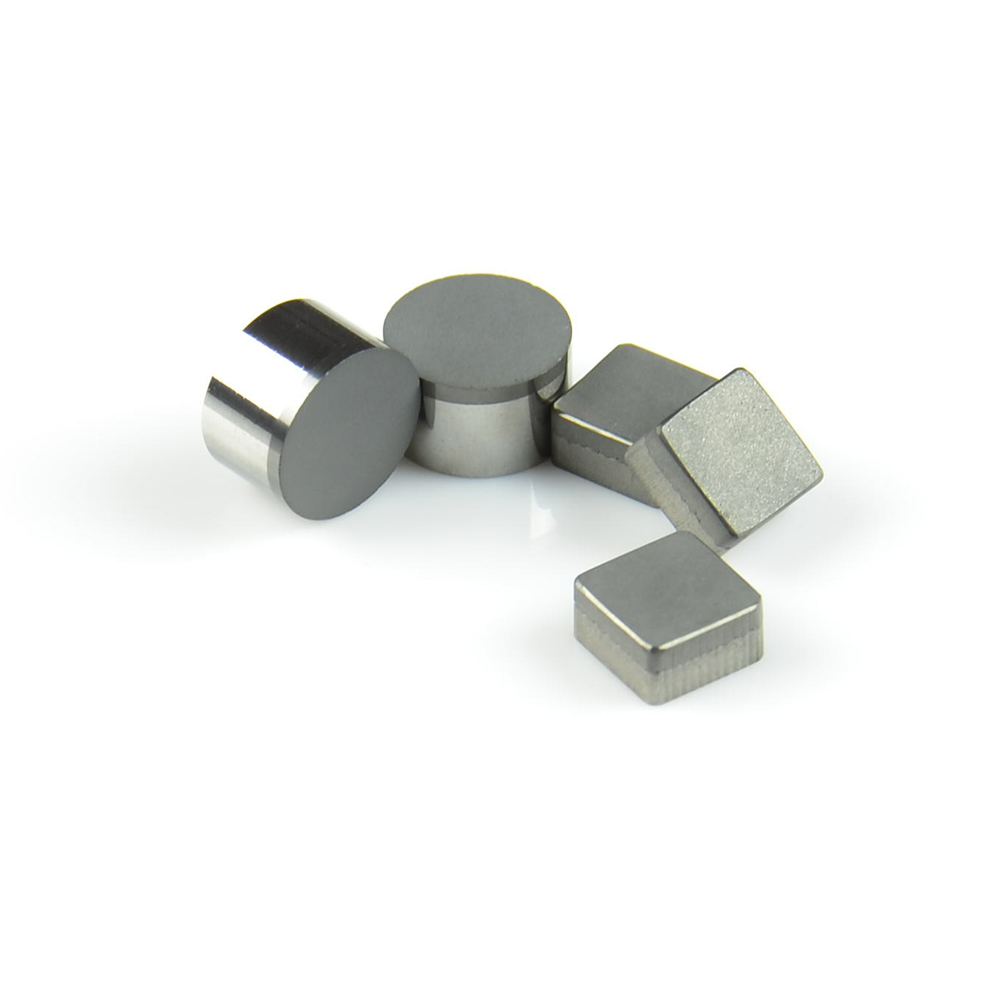
Polycrystalline diamond (PCD) and polycrystalline diamond compact (PDC) are key materials for cutting tools, drill bits and wire dies. The quality of the source diamond micron powder directly determines PCD/PDC performance and service life. This article examines powder requirements for PCD/PDC, the sintering process and applications.
What Are PCD and PDC
PCD (polycrystalline diamond) —sintered material of many diamond grains bonded together under high pressure and temperature using a catalyst (usually cobalt). PDC (polycrystalline diamond compact) —a PCD layer sintered onto a cemented carbide (WC-Co) substrate for increased strength and ease of mounting. PCD is used for cutting tools (turning, milling, drilling inserts), PDC —for drill bits (oil, gas, coal, geology) and wire dies.
Powder Requirements for PCD/PDC
PCD/PDC sintering imposes the highest requirements on diamond powder. Sintering density, PCD layer strength and thermal stability depend on powder quality. Key requirements:
- Near-spherical crystal shape —high flowability and packing density, promotes uniform sintering
- High strength (Raman 鈮?.7) —grains withstand high pressure without crushing
- Thermal stability —structure retention at 1100°C for 2— hours (ash test)
- Narrow particle size distribution —D10/D50/D90 strictly controlled
- Ultra-high purity —total impurities <16 ppm (ICP analysis)
- No rod/needle particles or flaky grains
PCD/PDC Sintering Process
PCD/PDC sintering takes place in high-pressure apparatus (belt press or cubic press type) in the following sequence:
- Preparation: diamond powder mixed with catalyst (cobalt, silicon) and placed in refractory metal container (tantalum, niobium, molybdenum)
- Assembly: powder container placed on carbide substrate (for PDC) or without (for PCD), assembly placed in pressure medium (pyrophyllite, salt)
- Sintering: pressure raised to 5— GPa, temperature to 1500—000°C, hold 3—0 min. Under pressure and temperature, cobalt melts and promotes diamond grain growth and diamond-diamond bonding
- Processing: extraction, cleaning from pressure medium, grinding, polishing, quality control
Effect of Grain Size on PCD Properties
| Grain size | PCD type | Strength | Wear resistance | Application |
|---|---|---|---|---|
| W40–W28 | Coarse-grained | High | Very high | Drilling, mining |
| W20–W14 | Medium-grained | Medium | High | Cutting tools, aluminum machining |
| W10–W7 | Fine-grained | Higher | Medium | Finishing, wood machining |
| W5–W1 | Ultra-fine | Highest | Low | Precision tools, ceramic machining |
PCD/PDC Applications
- PDC cutters for oil and gas drilling —working in abrasive formations (sandstone, limestone)
- PDC cutters for coal and geological drilling —drill bits for coal, ore, construction rock
- PCD cutting tools —turning, milling, drilling inserts for aluminum, copper, plastic, wood, carbon fiber
- PCD/PDC wire dies —drawing copper, aluminum and steel wire, including stainless steel
- PCD tools for wood and composite machining —milling cutters, saws, drills
Why a Bi-Modal Blend Beats a Monomodal One
Industrial PCD is rarely sintered from one narrow fraction. More often a blend of coarse and fine grains is laid: coarse grains form a strong skeleton, fines fill the gaps between them. This raises overall diamond share in the layer and sintered density, and with them wear resistance. With a single fraction, large voids remain between grains, later filled by binder cobalt, creating a weak spot in the working layer. So ordering PCD powder means ordering not a single number but a coarse-to-fine ratio. We tune that ratio for your drilling or machining task rather than shipping blind.
Which Powder for a Bit and Which for an Insert
Drill PDC cutters work abrasive rock where wear resistance and impact toughness rule, so coarse-grained PCD wins: it takes impact and wears slowly. Inserts for finish machining aluminum or wood instead need a sharp, stable edge and clean track, and here fine grain is chosen. The difference is not per-carat price but which property you trade away. Coarse grain lasts longer but leaves a rougher edge; fine grain gives gloss but abrades faster. Before ordering, answer honestly: is your main enemy rock downhole or a surface-finish requirement.
Common Questions on PCD Powder
Why does impurity content matter so much?
In a high-pressure cell, any foreign inclusion acts as a defect seed. Metallic impurities interfere with diamond-diamond bonding, and non-metallic inclusions remain in the finished layer as a fatigue point. For critical drill tools this is the difference between a bit and premature failure.
What is the ash test and why?
It is heating the powder at eleven hundred degrees for a couple of hours and weighing the residue. If nothing is left after that, thermal stability is insufficient and some diamond will burn out in your own sinter. The test rejects material not ready for the cycle.
Does PCD powder need a coating?
Classic PCD sinters in the presence of cobalt catalyst, so extra metallic coating is usually not required. Coating matters where there is little or no cobalt, and is agreed separately for your regime.
Brief Conclusion
PCD/PDC is a product where raw-material price loses to grain quality. What decides is not coarseness alone but its narrowness, purity and shape: grains must survive five to six gigapascals intact and intergrow without weak boundaries. For bit and insert makers this means ordering by a fixed specification with a certificate of distribution and impurities, not by a single catalogue size. We supply PCD-grade micron powder and back every batch with a report. Take a trial batch from 1 kg and trial-sinter it on your press before a bulk order.
How does PCD differ from natural single-crystal diamond in a tool?
Natural single crystal is very hard and polishes well, but brittle and costly, with limited size. PCD is a sintered polycrystal: cheaper at comparable hardness, allows wide blanks and behaves more stably under impact. The trade-off is slightly higher edge roughness and a lower maximum working temperature. So for high-speed finishing a single crystal is sometimes kept, while for loaded tools PCD almost everywhere wins.
What to ask in a PCD powder certificate?
At minimum: a guaranteed fraction with D10, D50 and D90, the ash-test result and metallic-impurity content. For critical drill tools, grain strength and flaky or needle-particle data help. If you run a bi-modal blend, lock the coarse-to-fine ratio separately, otherwise the second shipment may arrive with a different balance.
Need diamond powder for your project?
From 1 kg, standard W5/W10/W20 in stock —48h shipping. Custom fractions 3–7 days. Trial batch — from 1 kg.
Request a trial batch and a quote