When purchasing diamond micron powder, manufacturers face dozens of parameters in specifications: D50, D90, iron content, magnetic impurities, thermal stability, grain shape. Not all parameters are equally important — some are critical for PCD quality, others affect processing performance. This article breaks down each parameter in plain language.
Particle Size Distribution: D50 and D90
D50 (median diameter) — the grain size below which 50% of particles by volume fall. This is the main indicator of average grain size. D90 — the size below which 90% of particles fall. The difference between D90 and D10 shows distribution width: the narrower the distribution, the more predictable the processing.
| Parameter | What it means | Typical PCD-grade value |
|---|---|---|
| D50 | Average grain size | 3–18 μm |
| D90/D10 | Distribution width | ≤3 (narrow distribution) |
| D90 max | Max size (excluding outliers) | ≤ D50 × 2.5 |
Fe+Ni+Co Content: Critical for PCD
Iron, nickel and cobalt are the main metallic impurities in diamond powder, remaining after synthesis. For PCD sintering, these impurities are critical: they cause uneven sintering, reduce thermal conductivity and PCD strength. High-quality PCD-grade powder has total Fe+Ni+Co content below 65 ppm (0.0065%).
For PCD sintering, Fe+Ni+Co content below 65 ppm is not marketing, but a technical necessity. Impurities above 100 ppm lead to defects in the PCD structure.
Magnetic Impurities
Magnetic impurities are iron particles and compounds with magnetic properties. They differ from total Fe content: magnetic impurities are measured separately by magnetic separation. For high-quality powder, magnetic impurity content should be below 0.1%. These impurities are especially dangerous in optics and semiconductor polishing, where a scratch from an iron particle is costly.
Thermal Stability
Thermal stability of diamond powder determines at what temperature grain oxidation and graphitization begin. For PCD sintering at 1400–1600°C this is critical: low-thermal-stability powder breaks down before sintering completes. PCD-grade powder retains its structure up to 850°C in air (significantly higher in inert atmosphere). Thermal stability depends on grain surface purity and absence of crystal lattice defects.
Grain Shape (Crystallographic Form)
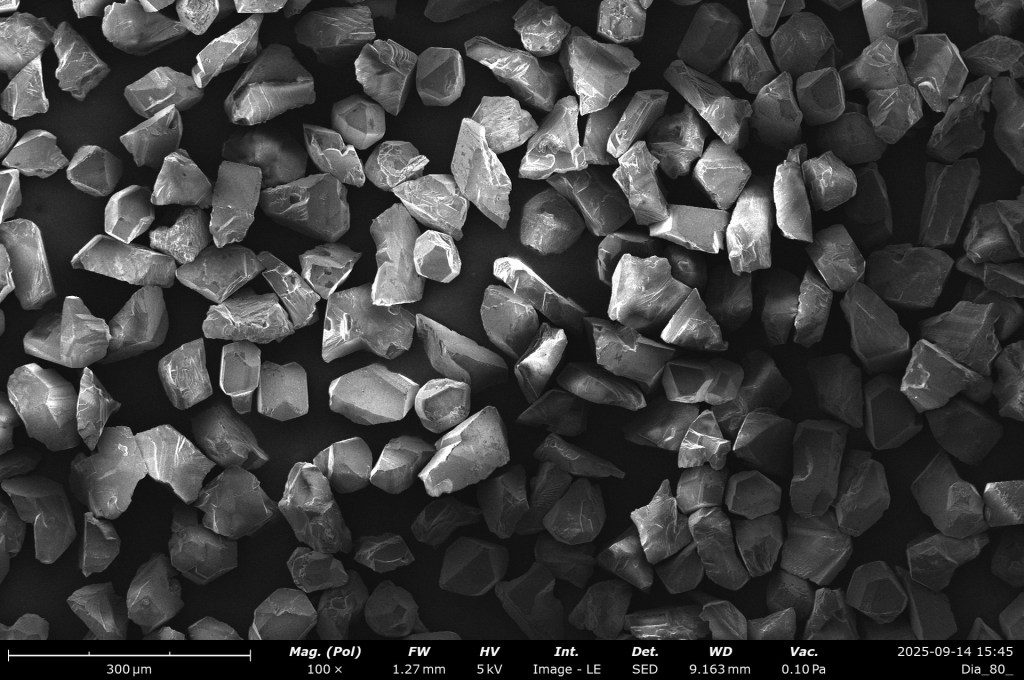
Grain shape affects cutting ability, packing density during sintering and surface roughness. Spherical (rounded) grains provide uniform packing and predictable processing. Sharp-edged grains cut better but wear faster. Shape classification: AAA (perfectly spherical), AA (spherical), A (mostly spherical), B (mixed form). For PCD, AAA and AA are preferred.
Bulk Density
Bulk density shows how many grams of powder fit in one cubic centimeter when freely poured. This parameter is important for packaging volume calculation and sintering dosing. Typical value for W10 diamond micron powder is 1.2–1.8 g/cm³. Bulk density depends on grain shape and size distribution: wider distribution gives higher density due to fine particles packing between coarse ones.
Which Parameters Matter for Your Application?
| Application | Critical parameters |
|---|---|
| PCD sintering | Fe+Ni+Co, thermal stability, grain shape, D90/D10 |
| Tool sharpening | D50, magnetic impurities, grain shape |
| Optics polishing | magnetic impurities, D90 max, grain shape |
| Stone processing | D50, bulk density, price |
Don't overpay for parameters that don't matter for your application. For stone processing, PCD-grade with Fe+Ni+Co <65 ppm is not needed — it increases price 2–3 times without practical benefit.
Frequently Asked Questions
Which parameter is most critical for PCD sintering?
For PCD sintering, a combination of parameters is critical: grain strength, thermal stability (up to 850 °C), Fe+Ni+Co content (< 65 ppm) and magnetic inclusions (< 0.1%). Deviation in any parameter reduces PCD blank quality.
Can PCD-grade micron powder be used for stone polishing?
Technically yes, but economically impractical: PCD-grade costs 2–3 times more, while standard micron powder with D50 control is sufficient for stone polishing. Overpaying for low impurities provides no practical benefit.
How often should particle size be checked?
For serial production, we recommend checking every batch at incoming inspection. We provide particle size analysis reports (D10, D50, D90) for every batch. Official Chinese state lab reports available on request.
Related Articles
Key takeaways for buyers
- D50 is the primary parameter for fraction selection; ±3.8% deviation is considered normal.
- Fe+Ni+Co below 65 ppm is mandatory for PCD sintering — otherwise the compact will crack.
- Always request a particle-size report for each batch — D10/D50/D90 values may differ from declared.
Diamond Powder Grade System: YD10 to YD90
China uses an 8-level diamond monocrystal classification system YD10–YD90, which directly affects micron powder quality:
- YD10–YD20 — basic strength, for rough stone processing and budget tools
- YD30–YD40 — regular crystal shape, medium heat resistance, for marble/granite saws and diamond drills
- YD60 — low impurities, high stability, for reinforced concrete cutting discs
- YD80–YD90 — virtually impurity-free, military/semiconductor grade, for precision cutting tools and SiC processing
The higher the raw material grade, the narrower the micron powder distribution and lower the impurity content after purification.
Real ICP Analysis Data: SCMD-AA Purity
Here are actual ICP elemental analysis results for SCMD-AA premium micron powder:
Impurity control is achieved through acid purification in the laboratory using analytically pure acids. For PCD sintering, total Fe+Ni+Co below 65 ppm is critical.
How Parameters Are Verified: Measurement Methods
The credibility of a specification depends directly on the measurement methods. Particle size distribution is determined by laser diffraction according to ISO 13320:2020: in one run the instrument outputs the volume-based distribution and yields D10, D50, D90 and D95. Metallic impurities are measured by ICP-OES — inductively coupled plasma optical emission spectrometry — which reliably detects Fe, Ni, Co and Si at the single-digit ppm level. Magnetic impurities are extracted by magnetic separation and weighed. Grain shape is assessed from SEM micrographs with automatic roundness and flake-ratio counting. Thermal stability is checked by thermogravimetric analysis in air, recording the oxidation onset temperature. Always ask the COA to state the method and reference document: "per ISO 13320:2020" is far more informative than a generic "laser analysis".
Buyer Checklist: What to Verify Before Ordering
Before sending an inquiry, compare the spec sheet with your process requirements. We recommend checking five points:
- Fraction and D50 — must match your process: PCD sintering usually needs 3–18 μm, finish optics polishing needs W0.5–W5.
- D50 tolerance — ask for the guaranteed batch-to-batch repeatability band (typically ±3.8% for SCMD-AA).
- Metallic and magnetic impurities — for PCD, total Fe+Ni+Co must be ≤65 ppm and magnetic impurities ≤0.1%.
- Per-batch report — a COA with actual D10/D50/D90, not catalogue averages.
- Supply terms — W5/W10/W20 are in stock with 48h dispatch, MOQ from 1 kg, trial batch from 1 kg with a per-batch report.
Two Questions Buyers Ask Most Often
Why do two powders with the same D50 perform differently?
D50 is only the median. Two powders can share the same average size yet differ in distribution width (D90/D10), grain shape and the share of oversize particles. A powder with a narrow distribution and rounded blocky grains delivers more stable processing than one with the same D50 but a tail of oversize particles. That is why we control not only D50 but also D90, D95 and flake ratio.
Do I need PCD-grade powder for a one-off trial batch?
For a trial, the minimum batch of 1 kg in a standard fraction is enough to assess compatibility with your process. PCD-grade with ultra-low impurities becomes worthwhile once the process is tuned and stable batch-to-batch yield matters.
Trends: Why the Requirements Bar Is Rising
As precision processing evolves — SiC substrate polishing, diamond polishing pastes for optics, PCD sintering for drilling tools — the industry moves toward narrower distributions and lower impurities. A decade ago, controlling D50 alone was enough for PCD; today buyers increasingly request D90/D10, roundness and an ICP report per batch. The industrial cluster's producers respond by expanding acid purification and automatic classification capacity, keeping prices below European equivalents at a comparable quality level.
Conclusion: parameters work for your result
A well-matched micron powder is not the most expensive line in your tool or polishing cost, yet it directly determines part yield and process stability. Identify which parameters are critical for your application, request a per-batch report, and avoid overpaying for unnecessary purity grades. Start with a trial batch from 1 kg, verify compatibility with your equipment — and only then move to a serial order from 1 kg.
Product inquiry
Fill in 4 fields — we reply within 1 business day. Or message us directly on VK / MAX.
Request a quote