A diamond tool is not just "a wheel with diamonds." Its working life and surface quality are determined by three independent variables: the diamond grit itself, the bond that holds it, and the tool geometry. Most grinding problems — loading, rapid wear, scratches on the workpiece — arise not from poor diamond, but from wrong bond or concentration selection. Let's see how this works.
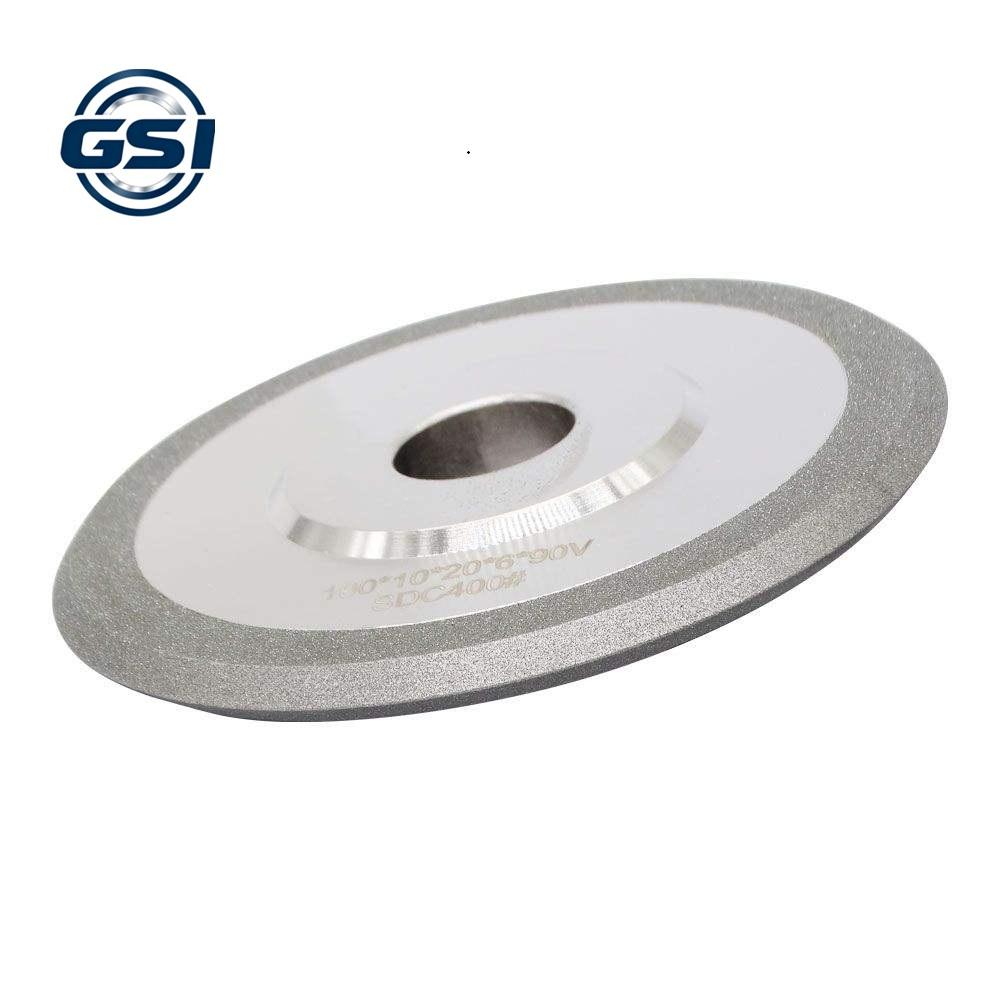
1. What is a "Bond" and Why It Matters More Than the Diamond
The bond is the material that holds diamond grit in the wheel's working layer. Diamond alone is too brittle to work directly; it must be held securely, but not so rigidly that a worn grain cannot fall out and expose a fresh one. This property — self-sharpening — makes the bond the key element.
Four Main Bond Types
| Bond | Material | Hardness | Best for |
|---|---|---|---|
| Resinoid (B) | Phenol-formaldehyde resin | Soft–medium | Precision grinding, finishing, tungsten carbide |
| Metal (M) | Bronze, powder metal | Hard | Rough grinding, stone, concrete, glass |
| Vitrified (V) | Clay ceramic frit | Medium–hard | Tool sharpening, high speed, coolant |
| Electroplated (P) | Nickel plating | Very hard | Saw blades, profiling, high stock removal |
How the Bond "Self-Sharpens"
During grinding, the diamond grain works with a sharp edge. Gradually its tip dulls — the cutting force on it grows. If the bond is soft, it fractures under this load, and the dull grain falls out, exposing a fresh one. If the bond is too hard, the grain keeps dulling, burning the workpiece and causing wheel loading. Matching bond hardness to the workpiece material is the core engineering skill.
2. Diamond Concentration: How Many Grits Are Needed
Concentration is the diamond mass in grams per 1 cm³ of working layer. Standard scale: 100% = 4.4 carats/cm³ (≈ 0.88 g/cm³). In practice, 25%, 50%, 75%, 100% and 150% are used.
- High concentration (100–150%): more sharp grains per unit area → better surface finish, but more expensive and less bond volume (faster wear).
- Medium concentration (50–75%): balance between cost, finish and life. Standard for most operations.
- Low concentration (25%): little diamond, more bond → cheaper, but rougher. Suitable for rough grinding of soft materials.
Beginner mistake: choosing max concentration "just in case." For fine finishing, 150% concentration gives worse, not better roughness — grains are too densely packed, no chip clearance between them, and the wheel loads up.
3. Grit Size: From Coarse W40 to Fine W0.5
Grit size determines the cutting depth and final surface roughness Ra. General rule: finer grain gives cleaner surface, but lower productivity and higher temperature.
| Grade | D50, μm | Operation | Ra, μm |
|---|---|---|---|
| W40 | 40 | Rough grinding | 0.8–1.6 |
| W20 | 20 | Semi-finish | 0.4–0.8 |
| W10 | 10 | Finish grinding | 0.2–0.4 |
| W5 | 5 | Precision | 0.1–0.2 |
| W2.5 | 2.5 | Polishing | 0.05–0.1 |
| W0.5 | 0.5 | Superfinish | < 0.025 |
4. Matching the Tool to the Job: Practical Cheat Sheet
- Sharpening VK8/T15K6 inserts: resinoid bond B100, ASM 10/20 grit, 75% concentration. Soft bond self-dresses, doesn't burn tungsten carbide.
- Granite/marble cutting: metal bond M, wide segment 35/40, 35–50% concentration. Metal holds grit to the end, withstands high cutting temperatures.
- Optical precision finishing: vitrified bond V, ASM 3/5 down to 0.5/1, 100% concentration. Vitrified doesn't load with diamond dust, holds profile shape.
- Glass/silicon grinding: electroplated bond P, single nickel coating, 60/80 grit. Single layer of grit on steel core — maximum productivity.
5. Common Selection Mistakes
- Choosing "hard" bond for soft material. Soft material (aluminum, copper) clogs even a soft bond. Need harder or open structure.
- Confusing "finer grit = better." Finer grit gives better roughness, but 5–10× lower productivity and 3× higher temperature. W5 for roughing is a waste of money.
- Ignoring coolant. Diamond oxidizes in air above 700–800 °C. Without coolant the wheel "burns," grains oxidize, life drops severalfold. For resinoid bond, abundant emulsion is especially critical.
Bottom line: a diamond tool works well not when the diamond is the most expensive, but when bond, concentration and grit are matched to the specific material and operation. The same diamond in the right bond lasts 3–5× longer and gives a better surface.