Stone cutting blades are the largest segment of industrial diamond consumption in the world (about 40% of total volume). Blade manufacturers face a dilemma: too coarse diamond gives high cutting speed but wears fast and causes edge chipping; too fine — durable but cuts slowly and "glazes". Correct grain size and concentration selection determines 70% of blade performance.
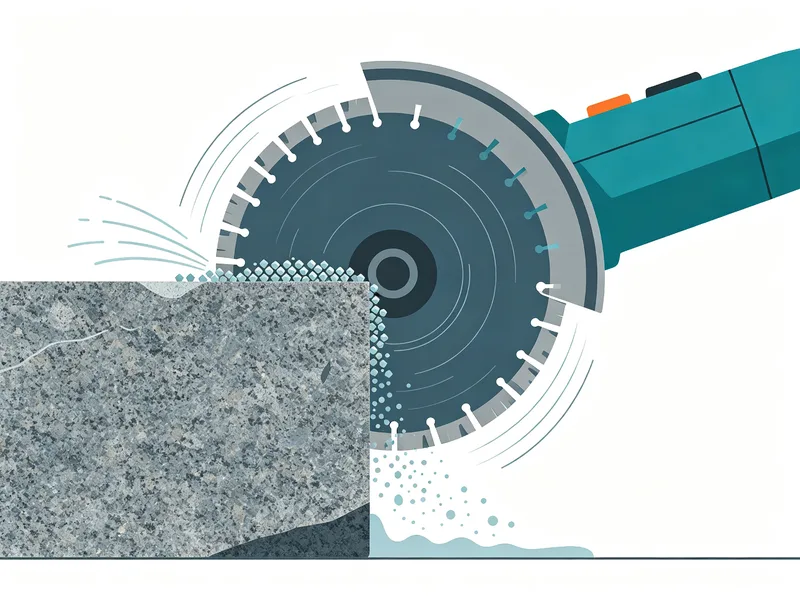
⚠️ This article is an educational overview of coarse-grained diamond applications in stone-cutting saw blades (coarse grit). DIAMTECH specializes in PCD-grade ≤20μm diamond micron powder; coarse grades described here are not our standard products.
Grain Size Selection by Stone Type
| Material | Hardness/Abrasiveness | Grain size (mesh) | W-equivalent |
|---|---|---|---|
| Hard granite (gabbro, basalt) | High hardness, low abrasiveness | 30/40 – 40/50 | W50–W63 |
| Medium granite | Medium hardness | 40/50 – 50/60 | W40–W50 |
| Marble, limestone | Low hardness, high abrasiveness | 50/60 – 60/80 | W28–W40 |
| Porcelain tile, ceramic | Very high hardness, brittle | 60/80 – 80/100 | W20–W28 |
| Concrete, asphalt | Medium abrasiveness, with rebar | 30/40 – 40/50 | W50–W63 |
| Sandstone, travertine | Low hardness, porous | 40/50 – 50/60 | W40–W50 |
Diamond Concentration: Key Parameter
Diamond concentration in the segment is measured in carats per cubic centimeter (ct/cm³) or as volume percentage. Standard concentration for industrial blades — 1.5–3.5 ct/cm³ (25–50% by volume).
| Concentration | ct/cm³ | Cutting speed | Blade life | Application |
|---|---|---|---|---|
| Low | 1.0–1.8 | High | Low | Fast-cutting blades, marble |
| Medium | 1.8–2.5 | Medium | Medium | Universal blades, granite |
| High | 2.5–3.5 | Below medium | High | Long-life blades, concrete |
Grain Shape and Bond Type
Grain Shape
- Sharp-edged (crushed) — for hard abrasive materials (granite, concrete). Sharp edges effectively penetrate the material. TI (strength) should be high (≥ 60%) so grains don't break prematurely.
- Intermediate (blocky) — universal shape for most applications. Balance between cutting speed and durability.
- Spherical (rounded) — for brittle materials (porcelain tile, glass). Spherical grains don't cause chipping on the cut edge.
Bond Type
- Metal bond (Cu-Sn-Co, Fe-Cu) — most common for stone cutting blades. High diamond holding strength, good thermal conductivity. Bond wear should match diamond wear — if bond is too hard, blade "glazes"; if too soft, diamond falls out unused.
- Ceramic bond — for precision cutting of porcelain tile and glass. High porosity, sharp self-sharpening, but lower strength.
Common Mistakes in Blade Manufacturing
- Using too fine powder for granite — blade cuts slowly, overheats, bond doesn't wear ("glazing"). For hard granite always use 30/40–40/50 mesh.
- Too high concentration for marble — marble is abrasive, bond wears fast, diamond falls out unused. For marble, low concentration (1.0–1.8 ct/cm³) is optimal.
- Ignoring diamond strength (TI) — for concrete and granite with high impact load, diamond with TI ≥ 60% is required. Low-strength diamond (TI < 50%) breaks in a few cuts, blade loses effectiveness.
- Bond-material mismatch — for abrasive materials (marble, sandstone) need hard bond (slow wear), for hard materials (granite, porcelain) — soft bond (quickly exposes new grains).
Segment Manufacturing Methods and Powder Requirements
The segment manufacturing method directly affects diamond powder requirements. There are two main process routes:
Hot Pressing
A mixture of metal powder (Cu, Sn, Co, Fe, Ni) and diamond is placed in a graphite die and heated to 700–900°C under 15–25 MPa for 5–15 minutes. During hot pressing, diamond grains experience thermal and mechanical stress, so powder with high thermal toughness (TTI ≥ 50%) and high TI (≥ 60%) is required. Low-strength diamond partially breaks during sintering, reducing segment cutting ability. Optimal grain size for hot pressing is 30/40–50/60 mesh.
Cold Press + Sintering
The segment is first cold-pressed at 200–400 MPa, then sintered in a furnace under protective atmosphere (argon, hydrogen) at 750–850°C for 2–4 hours. This method gives a more uniform structure and less diamond damage, but requires a wider process window. For cold pressing, powder with TI 50–60% is acceptable, but better flowability (spherical or blocky grain shape) is required for uniform distribution throughout the segment.
Layered (Sandwich) Segment Structure
Modern high-performance blades use layered segments where different layers have different diamond concentration and grain size:
| Layer | Grain size | Concentration | Purpose |
|---|---|---|---|
| Top (working) | 40/50–60/80 | 2.5–3.5 ct/cm³ | Aggressive cutting, high speed |
| Intermediate | 50/60–70/80 | 1.5–2.0 ct/cm³ | Balance of speed and life |
| Bottom (support) | 60/80–80/100 | 1.0–1.5 ct/cm³ | Segment retention, vibration damping |
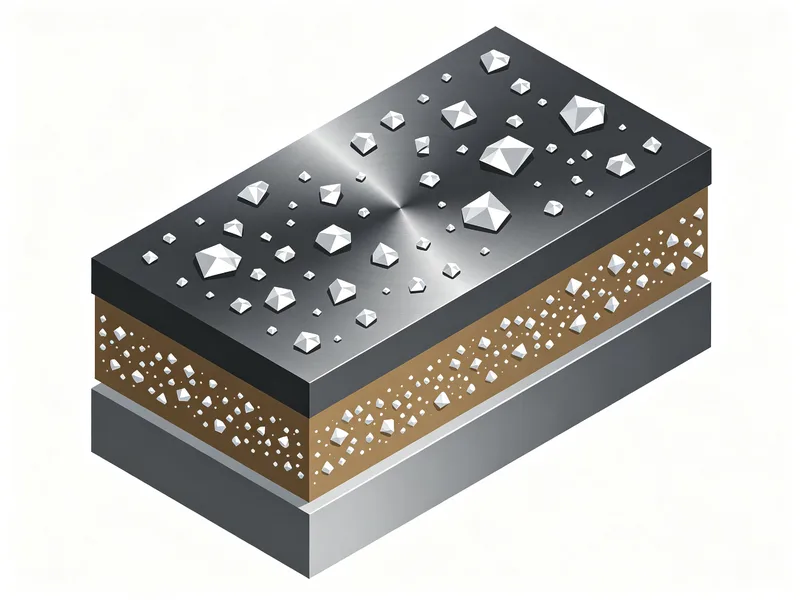
The layered structure improves blade life by 20–30% compared to a homogeneous segment at the same total diamond cost. However, it requires precise dosing and layer separation during pressing — technologically more complex.
Cooling and Cutting Parameters
Correct diamond selection does not guarantee results without optimal cutting parameters. Key parameters:
- Blade linear speed: 25–35 m/s for granite, 35–45 m/s for marble and soft stone. Too high speed overheats diamond and causes graphitization; too low increases vibration and chipping.
- Feed rate: 0.5–1.5 m/min for granite, 1.5–3.0 m/min for marble. Too fast feed causes impact overloads and segment chipping.
- Cooling: 8–15 L/min of water for a 350–500 mm dry-cutting blade. Water not only cools the cut zone but also removes slurry, preventing abrasive bond wear by swarf. Dry cutting (without water) is only acceptable for wall saws with air cooling and a specially soft segment.
Diamond Selection Checklist for Blades
- Determine stone type and its Mohs hardness / abrasiveness.
- Select grain size using the table above (30/40 for hard granite, 60/80 for porcelain).
- Determine required concentration (low for speed, high for life).
- Specify TI ≥ 60% for hot pressing and hard stone.
- Match bond hardness to stone abrasiveness (hard bond for abrasive stone, soft bond for hard stone).
- Order a trial batch of 2–3 segments and conduct production trials.
Comparison with Alternative Abrasives: When Diamond Is Not Needed
Diamond is the hardest abrasive (10000 HV), but not always the most economical. For very soft and abrasive materials (limestone, sandstone), silicon carbide (SiC, 3000 HV) or zirconia alumina is sometimes more cost-effective. Analysis of cases where diamond is overkill:
- Soft limestone and highly abrasive marble — diamond is too quickly "eaten" by abrasion, and in the end a wheel with SiC grains or carborundum segment lasts longer at lower cost. But this is only true for one-off or seasonal work — for continuous production, diamond still pays off.
- Glass and ceramic processing where cut quality matters more than speed — here diamond is irreplaceable, because CBN and SiC scratch the surface.
The conclusion is simple: diamond segments pay off where hard abrasive material (granite, concrete, porcelain) is processed in serial production mode. For one-off work on soft stone or for maintenance crews, SiC wheels may be more economical.
Practical conclusion: diamond powder selection for stone cutting blades is always a compromise between cutting speed and blade life. The optimal configuration is determined by stone type (hardness and abrasiveness), which dictates grain size, grain shape and bond hardness. Always test 2–3 powder variants on your equipment — laboratory data cannot replace production trials.
Segment Design and Grain Choice
The cutting segment of a circular stone blade is a composite: diamond powder held by a metal bond (matrix). Grit is matched to stone hardness, bond hardness to its abrasiveness. For soft stone (marble) use a harder bond and coarse grit (30–50 μm): the bond wears slowly, holding large grains. For hard abrasive stone (granite) use a soft bond and fine grit (20–40 μm) so diamonds expose in time and do not "glaze over".
- Marble/limestone: hard bond, 30–50 μm.
- Granite/quartzite: soft bond, 20–40 μm.