Diamond is not just a gemstone. Thanks to its unique hardness (Mohs 10), high thermal conductivity and chemical resistance, diamond is an indispensable industrial material. More than 95% of all mined and synthesized diamonds are used in industry. In this article we explore 7 key industries where diamond plays a crucial role.
1. Cutting Tools
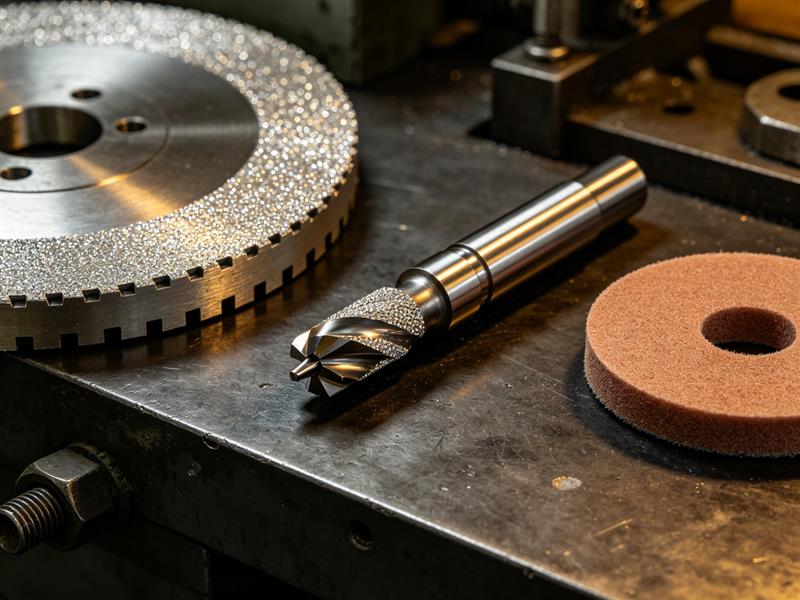
Diamond cutting wheels and saws are the primary tools for processing hard and abrasive materials that cannot be cut with conventional high-speed steel or carbide tools.
- Stone processing: cutting granite, marble, sandstone, quartzite into slabs and blocks. Diamond wire saws and circular saws provide precise cutting with minimal material loss.
- Construction: cutting reinforced concrete, asphalt, brick during demolition and repair. Diamond drilling allows holes without impact load.
- Glass and ceramic processing: precise cutting of sheet glass, glass-ceramics, ferrite, semiconductor wafers.
- Carbon composite processing: carbon fiber reinforced plastic (CFRP), boron fiber — materials that quickly wear out conventional tools.
2. Grinding and Lapping
Diamond grinding wheels, pastes and suspensions are used for precision processing where high surface finish and precise geometry are required.
- Cutting tool sharpening: carbide saws, mills, drills, turning tools. Diamond wheels provide precise cutting edge geometry.
- Carbide grinding: processing parts from VK8, T15K6 and other grades that cannot be processed with conventional abrasives.
- Lapping and polishing: achieving mirror surface on parts from ceramics, glass, metals. Diamond pastes provide roughness Ra < 0.01 μm.
- Optics processing: grinding and polishing lenses, prisms, windows from optical glass and crystals (sapphire, CaF₂, ZnSe).
3. Drilling and Exploration
Diamond core bits and PDC drill bits are the primary tools for geological exploration and mineral extraction in hard rock formations.
- Exploration drilling: extracting core (rock sample) for studying geological structure. Diamond core bits provide high drilling speed and core integrity.
- Oil and gas drilling: PDC (polycrystalline diamond compact) drill bits for drilling wells in hard formations. PDC bit service life is 5–10 times higher than conventional bits.
- Mining: drill rods and core bits for driving excavations in mines.
- Construction drilling: diamond drilling holes in reinforced concrete for engineering utilities.
4. Wire Drawing
Diamond dies — drawing dies with a hole for pulling metal wire. This is one of the oldest industrial applications of diamond, known since the 19th century.
- Fine wire production: from steel, copper, aluminum, gold, platinum. Diamond dies provide precise diameter (down to 0.01 mm) and high surface finish.
- High wear resistance: diamond die service life is 100–200 times higher than carbide dies. This is critical in fine wire production.
- Electrode production: tungsten and molybdenum wire for incandescent lamps and electrodes.
5. Electronics and Thermal Management
Diamond is the best known thermal conductor (2000–2500 W/(m·K), 5 times better than copper). This property makes diamond indispensable in modern microelectronics, where heat dissipation is a critical problem.
- Heat sinks for high-power chips: diamond substrates and films for heat dissipation from high-power transistors and laser diodes.
- High-voltage electronics: diamond heat sinks for power modules and converters.
- Sensors: diamond pressure and temperature sensors for operation in aggressive environments and at high temperatures (up to 1000 °C).
- CVD diamond films: deposited on silicon substrates to improve thermal conductivity.
6. Gemstone Processing
Only another diamond can process diamond — this unique property has been known since antiquity. Diamond wheels, powders and pastes are the primary tools of jewelry factories.
- Diamond cutting: only another diamond can cut diamond. Diamond wheels and powders are the primary tools of jewelry factories.
- Other gemstone processing: ruby, sapphire, emerald, topaz — all processed with diamond tools.
- Jewelry polishing: diamond pastes for final polishing of gold, platinum, silver.
7. Medicine and Other Special Applications
- Surgical instruments: diamond scalpels for eye microsurgery and neurosurgery. The diamond scalpel blade has atomic sharpness, providing a clean cut and rapid healing.
- Bearings and seals: diamond coatings for parts operating under high friction and aggressive conditions.
- Abrasion-resistant coatings: CVD diamond coatings on pump parts, valves, pipelines for handling abrasive media.
- Scientific research: diamond anvil cells for creating pressures up to 400 GPa when studying matter under extreme conditions.
- Acoustic transducers: diamond diaphragms for high-quality headphones and audio systems (high stiffness ensures accurate high-frequency reproduction).
Diamond is a unique material combining properties found in no other substance: maximum hardness, maximum thermal conductivity, chemical inertness and optical transparency. This combination makes diamond indispensable in modern industry.
Interesting Facts
- Industrial diamonds account for 95% of world production, but only 20% of its value.
- One diamond cutting wheel can process 1000 times more granite than a silicon carbide wheel.
- Diamond drilling can penetrate 10–20 meters of rock per hour, while conventional drilling — 1–2 meters.
- The thinnest wire drawn through a diamond die has a diameter of 0.001 mm (1 micrometer).
- Diamond scalpels have been used in ophthalmology for over 50 years and still have no analogs in sharpness.
Which Powder Grade Is Needed in Each Industry
| Industry | Typical grit | Purity class | Grain shape |
|---|---|---|---|
| Cutting tools (PCD) | W5–W20 | PCD-grade ≤65 ppm | spherical |
| Carbide grinding | W7–W40 | industrial | sharp |
| Drilling (PDC bits) | W5–W30 | PCD-grade | spherical |
| Wire drawing | W10–W28 | industrial | rounded |
| Optics & semiconductors | W0.5–W5 | ≤16 ppm | spherical |
| Stone processing | W20–W40 + mesh | standard | sharp |
| Medical | W1–W10 | ≤16 ppm | spherical |
This table is a starting point. The exact recipe is tuned for a specific machine, contact pressure, and required roughness; see also the related industry articles.
Why Diamond Has Displaced Traditional Abrasives
Until the mid-20th century, the main abrasives were fused alumina (Al₂O₃) and silicon carbide (SiC). Their hardness is 2000–3000 HV versus 10000 HV for diamond. This means that when grinding hard alloys (WC-Co, ~1500–2000 HV), hardened steels, and ceramics, conventional abrasives dull in minutes, while a diamond grain retains its cutting edge dozens of times longer. For iron-containing materials diamond has a limitation: at high temperatures it reacts with iron (carbide formation), so cubic boron nitride (CBN) is more effective for steel grinding. But for non-ferrous metals, ceramics, glass, stone, and hard alloys there is no equal to diamond.
Future Directions
On the horizon is growing demand for diamond micron powder in new industries: polishing SiC and GaN wafers for power electronics, manufacturing diamond heat spreaders, grinding transparent ceramics for ballistic glass and IR sensor windows. These applications require ultra-fine fractions (W0.1–W1) and high purity (≤5 ppm), which drives development of HPHT synthesis and submicron powder classification methods.
When choosing a supplier for a specific industry, always request COAs for the exact same applications you plan: powder previously used in PCD tools is not always suitable for SiC wafer polishing. The supplier's experience in your segment matters more than the lowest price.
Industries and Typical Grit — Summary Table
| Industry | Process | Grit |
|---|---|---|
| Machinery | Grinding | 8–30 μm |
| Electronics | Wafer polishing | 0.25–3 μm |
| Optics | Finish | 0.5–2 μm |
| Oil & gas | PDC bits | 2–30 μm |
| Construction | Stone cutting | 20–50 μm |