Diamond micron powder is one of the most versatile abrasive materials. Thanks to exceptional hardness (Mohs 10), high thermal conductivity and chemical inertness, it is used in dozens of industries. In this article we describe 10 main application areas and give grain size selection recommendations for each.
1. PCD tool manufacturing
The largest application of diamond micron powder — manufacturing polycrystalline diamond (PCD) for cutting tools. PCD blanks are sintered from diamond powder with cobalt binder on WC substrate at high pressure and temperature. Recommended grain sizes: W10-W20 for base layer, W5-W10 for top working layer. Purity requirement: at least 99.9%.
2. Carbide tool sharpening and lapping
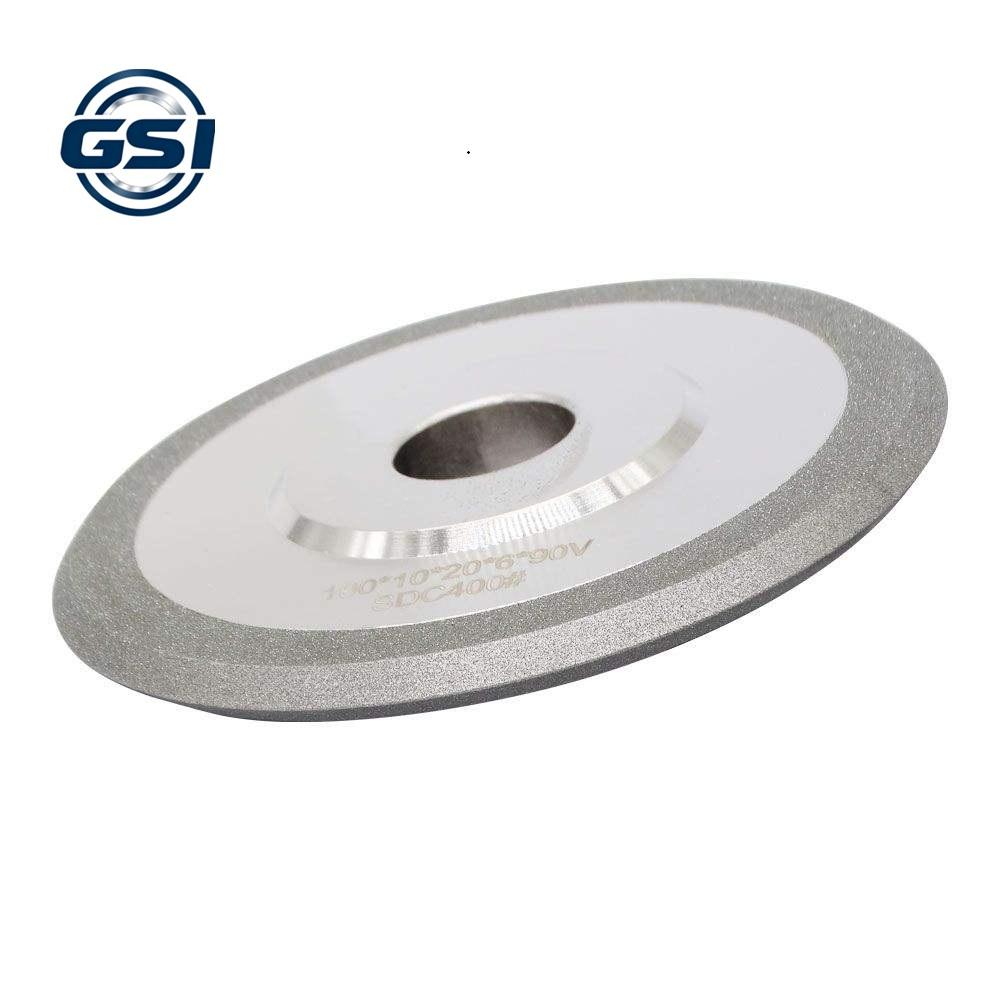
Sharpening carbide (WC-Co) mills, drills, inserts and broaches requires diamond micron powder to achieve high cutting edge finish. Used as suspensions for diamond wheels and lapping pastes. Recommended grain sizes: rough sharpening W20-W40, semi-finish W10, finish W5, super-finish W3-W1 (on request).
3. Optical component polishing
Polishing lenses, prisms, windows from optical glass and crystals (sapphire, quartz) requires ultra-fine diamond micron powders. Used as water or oil-based polishing suspensions. Recommended grain sizes: W5 for pre-polishing, W3-W1 for final, W0.5 and finer for super-polishing (on request).
4. Natural and artificial stone processing
Cutting, grinding and polishing granite, marble, quartzite, porcelain stoneware and artificial stone uses diamond micron powder in diamond blades, segments and polishing wheels. Recommended grain sizes: cutting W40-W60, grinding W20-W40, polishing W10-W20.
5. Ceramic processing
Grinding and polishing technical ceramics (alumina, silicon nitride, silicon carbide, zirconia) requires diamond micron powder due to high hardness of these materials. Used in diamond wheels and lapping pastes. Recommended grain sizes: W10-W20 for grinding, W5-W10 for polishing.
6-10. Other areas
- Electronics: cutting and polishing silicon wafers, sapphire substrates for LED — W3-W10
- Automotive: lapping valves, piston rings, fuel injectors — W5-W20
- Aerospace: processing heat-resistant alloys and composites — W10-W40
- Medical: polishing surgical instruments and implants — W3-W10
- Jewelry: gemstone cutting and polishing — W1-W10
Didn't find your application area? Contact us — we will select the optimal grain size and help you plan a trial batch.
Practical tip
For a first purchase we recommend a trial batch from 1 kg: test the fraction on your equipment before a bulk order. Every trial batch comes with a report (particle size, Fe+Ni+Co). Standard W5/W10/W20 fractions are always in stock — ships within 48 hours.
Complete Diamond Tool Classification
Diamond micron powder is used in four main tool types:
- Cutting: circular saw blades, wire saws, band saws, diamond wire, PCD tools (turning, milling, drilling)
- Drilling: PDC bits, core bits, coal bits, stone/glass/ceramic drills
- Grinding: grinding wheels, discs, blocks, rollers, cups
- Polishing: polishing powders, pastes, suspensions
10 Application Industries and Required Powder Grade
| Industry | Tool | Powder Grade | Typical Fraction |
|---|---|---|---|
| Mining | PDC bits, wire saws | YD40–60, SCMD-B | W20–W40 |
| Stone processing | Blades, wire saws, polishing | YD30–40, SCMD-B/C | W7–W28 |
| Carbide | Metal bond wheels | SCD, SCMD-A | W10–W20 |
| Semiconductors (SiC) | Precision wheels, polishing | SCMD-AA, YD90 | W5–W10 |
| PCD/PDC | Composite sintering | SCMD-PCD/PDC | W5–W10 |
| Diamond wire | Electroplating | SCMD-WD | 5–50 μm |
How to Choose the Right Grain Size
Choosing grain size is the key step that determines both productivity and final surface finish. The general rule: move from coarse to fine, without skipping several steps. Roughness must drop smoothly between adjacent fractions: if you jump from W20 straight to W3, the stock from the previous step is never removed and you waste expensive fine powder. A typical chain for carbide: W40, W20, W10, W5, W3, W1. For each finer grain, you should remove roughly the damaged layer left by the previous one. If you only need high roughing productivity, stop at W20–W40; if you need a mirror surface and dimensional accuracy, lay out the full chain down to W0.5–W1.
Typical Roughness After Processing
The link between fraction and achievable Ra is roughly as follows (the exact value depends on the workpiece, bond and regime):
| Fraction | Stage | Ra, µm (guide) |
|---|---|---|
| W20–W40 | Rough grinding | 0.8–1.6 |
| W10–W14 | Semi-finishing | 0.3–0.6 |
| W5–W7 | Fine grinding | 0.1–0.25 |
| W1–W3.5 | Polishing | 0.02–0.08 |
| W0.5–W1 | Super-finishing | below 0.02 |
Frequently Asked Questions
How does SCMD-AA differ from SCMD-A and regular industrial powder?
SCMD-AA is the top grade with the tightest particle-size spread, lowest impurity content and selected grain shape; it targets semiconductors, optics and precision polishing. SCMD-A is the mid grade for general tooling. Regular industrial powder suits rough grinding, stone and drilling. Paying for the top grade only makes sense where a single oversize particle can ruin an expensive part.
Can I mix different fractions?
Blends are sometimes made to reach intermediate ranges, but reproducing the mix accurately requires experience and calibration. Ordering the exact fraction separately is more reliable, so the result stays consistent batch to batch.
Which powder for PCD and PDC?
Sintering PCD blanks and PDC bits needs a specialized powder with controlled shape and purity of at least 99.9%. The cobalt binder and extreme pressure and temperature place special demands on grain thermal stability; general industrial powder is unsuitable here.
Trends and Procurement Recommendations
Global demand for diamond micron powder grows as hard, non-metallic materials expand. Third-generation silicon-carbide semiconductors, sapphire LED substrates, laser optics and heat-resistant ceramics all call for finer, cleaner fractions. At the same time, consistency of particle size distribution batch to batch is tightening. For buyers, this means that choosing a supplier with reproducible quality and incoming inspection matters as much as price per kilogram. Start with a trial batch from 1 kg: test a common W5, W10 or W20 fraction on your equipment, and only then place a bulk order.
Why Demand for Micron Powder in Electronics Is Growing
Of the ten areas listed, the electronics industry shows the fastest growth in diamond micron powder consumption. The reason is the shift to silicon-carbide and sapphire substrates, which are notably harder and more brittle than ordinary silicon. Cutting and grinding such substrates with conventional abrasives causes chipping, micro-cracks and subsurface damage that lower wafer yield. Diamond micron powder with controlled grain shape allows processing with a minimal damaged layer, which directly raises good-die yield. For buyers in this industry, the key parameters are not only the mean size but also the upper bound of large particles and batch-to-batch consistency. That is why the top SCMD-AA grade, rather than standard industrial powder, is used here.
Brief Conclusion
Diamond micron powder remains indispensable wherever materials harder than aluminum oxide are processed or a finish-grade surface is required. Its use spans tool manufacturing, carbide processing, optics, stone, ceramics, electronics, automotive, medicine and jewelry. The universal recipe for a stable result is simple: identify the workpiece material and required roughness, select a fraction chain from rough to finish, match the powder grade to how critical the operation is, and verify the lot with a trial batch from 1 kg. This approach avoids overpaying for excess specs while preventing scrap from insufficient quality. We are ready to match the fraction and grade to your specific operation and send a trial lot for bench testing.
Product inquiry
Fill in 4 fields — we reply within 1 business day. Or message us directly on VK / MAX.
Request a quote