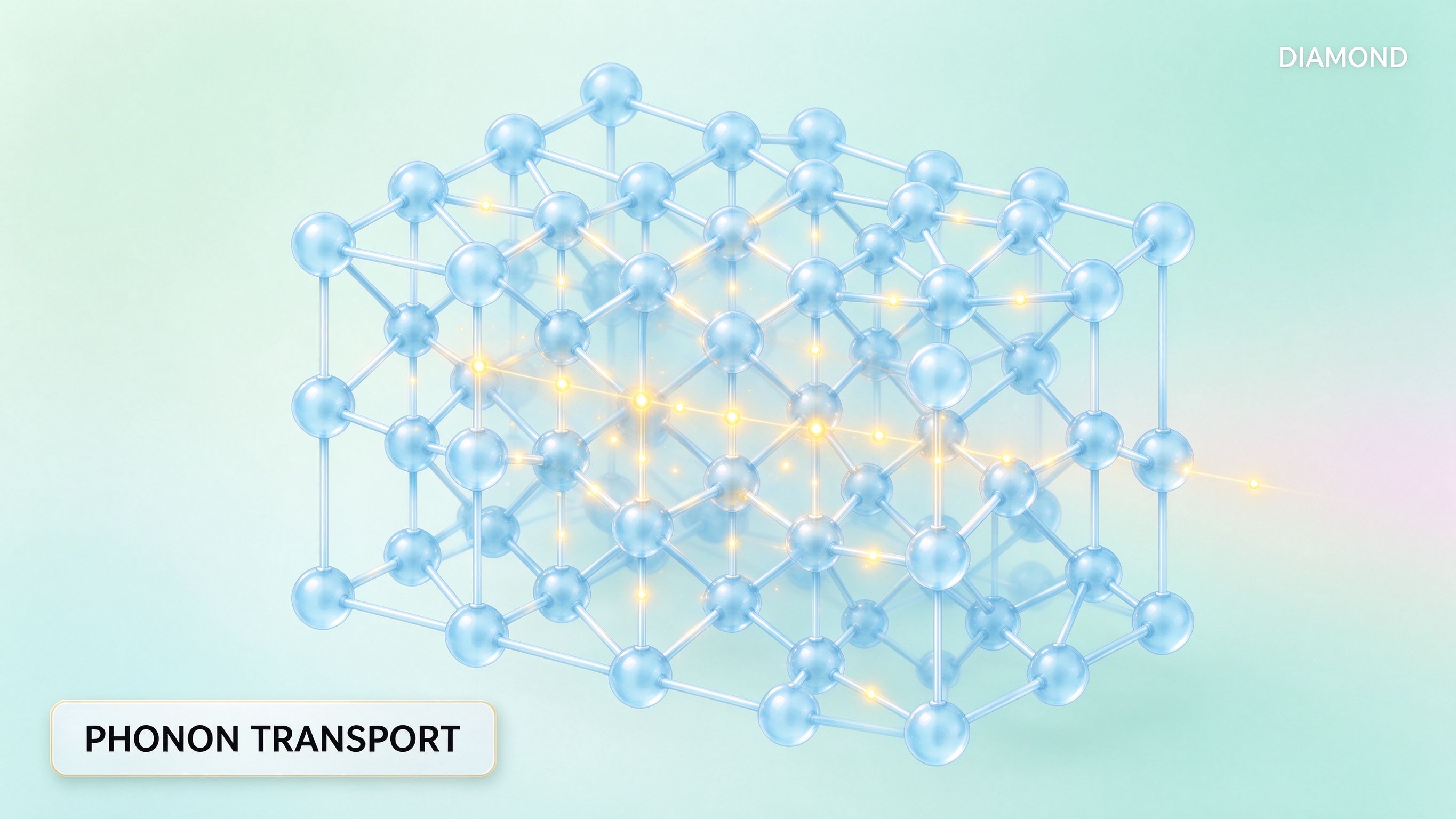
Diamond is the only material that both insulates electric current and conducts heat better than copper and silver. Its thermal conductivity reaches 900–2300 W/m·K at room temperature —about 5 times higher than copper and 4 times higher than silver. To understand where this number comes from and how to use it in practice, we need to look at how heat travels through a crystal. This article explains the phonon transport mechanism, why the diamond lattice is so efficient, how purity, isotope composition and temperature affect the result, and what this means for engineering applications.
⚠️ The thermal conductivity values in this article are reference physical properties of materials from open scientific sources, not characteristics of a specific batch. The real conductivity of diamond micron powder depends on purity, grain size and measurement method; in powder form it is always lower than that of a single crystal.
How Heat Travels Through a Solid
In metals, heat is carried mainly by free electrons. That is why a good heat conductor is almost always a good electrical conductor: copper, silver, aluminum. But there is a second, fundamentally different mechanism —heat transport by vibrations of the crystal lattice, which physicists call phonons. A phonon is a quantum of lattice vibration. When one region of the lattice heats up, atoms vibrate more strongly and pass energy to neighboring atoms. This wave of elastic vibrations is "phonon transport" of heat.
In electrical insulators (diamond, ceramics, sapphire) there are no free electrons, so phonons are the only path for heat transport. The conductivity of an insulator is entirely determined by how freely phonons "fly" through the lattice. This is where diamond is unique: its light carbon atoms, strong short bonds and extremely regular lattice let phonons move almost without obstruction. As a result, phonon transport speed in diamond is among the highest of all materials.
Why the Diamond Lattice Is So Efficient
The efficiency of phonon transport depends on several lattice factors. The first is atomic mass. The lighter the atom, the higher its vibration frequency and the faster energy is transferred. Carbon is one of the lightest elements, giving diamond an advantage from the start. The second is bond stiffness. In diamond, each carbon atom is bonded to four neighbors by strong covalent sp3 bonds in a tetrahedral configuration. This is the stiffest, most ordered structure of any known material, which minimizes phonon scattering. The third is lattice regularity. An ideal diamond crystal transmits phonons without scattering at defects; the fewer defects and impurities, the closer conductivity gets to the theoretical maximum.
How Purity and Isotopes Affect the Result
Real diamond conductivity rarely reaches the theoretical maximum, because there are always defects in the crystal. The most visible factor is nitrogen impurity. Natural diamond often contains nitrogen, which embeds in the lattice and scatters phonons. So natural diamond conductivity is usually lower (900–1600 W/m·K) than high-purity synthetic (up to 2000+ W/m·K). Another factor is isotope composition. Natural carbon contains about 1.1% of the 13C isotope, heavier than 12C. 13C disrupts lattice periodicity and scatters phonons. Highly isotope-purified diamond (almost 100% 12C) showed conductivity above 2300 W/m·K at room temperature —a record among materials.
| Diamond type | Conductivity, W/m·K | Comment |
|---|---|---|
| Natural (with nitrogen) | 900–1600 | Nitrogen scatters phonons |
| Synthetic HPHT/high purity | 1500–2000 | Fewer impurities, higher conductivity |
| Isotope-purified 12C | >2300 | Record for materials |
Phonon Mean Free Path and Lattice Defects
Physicists describe the efficiency of phonon transport through the "mean free path" —the distance a phonon travels before scattering. The longer the path, the higher the conductivity. In ideal diamond, the phonon mean free path reaches micrometers at room temperature —an enormous value compared with most materials. Any lattice irregularity —an impurity, a vacancy, a dislocation, a grain boundary—shortens the path and scatters phonons. This explains why conductivity in powder form is always lower than in a single crystal: in micron grains, a large share of volume is at boundaries where phonons scatter. That is why, when choosing diamond micron powder for thermal tasks, purity (fewer impurities —longer path) and grain size (coarser grains —less boundary share) are so important.
The Role of Temperature
Diamond conductivity depends strongly on temperature. At room temperature it is maximal or near-maximal. On heating (above ~200 °C), phonon–phonon scattering (U-processes) intensifies and conductivity starts to drop —roughly as 1/T. At cryogenic temperatures, by contrast, it can rise several-fold, because scattering decreases. For an engineer this means: diamond's advantage is especially large from room temperature up to ~200–300 °C, which covers most electronics tasks. Above this range diamond is still a good conductor, but the gap over metals narrows.
Practical Implications for Applications
- A thin diamond layer can carry a heat flux that copper would only handle through much larger area and thickness —saving space in power-electronics packages.
- Diamond simultaneously insulates electric current, allowing removal of intermediate insulating substrates in high-voltage modules.
- Powdered diamond keeps the advantage in composites: in thermal interfaces, the high intrinsic conductivity of the particles directly raises the material's effective conductivity.
- When choosing diamond micron powder for thermal tasks, purity and particle-size distribution are critical, because at the micron scale scattering at grain boundaries reduces effective conductivity.
Brief Conclusion
Diamond conductivity is the result of a unique combination: light atoms, stiff covalent bonds and a regular lattice, which together let phonons move almost without scattering. Practically, this gives a material with conductivity of 900–2300 W/m·K —several times above metals —while fully insulating electricity. Purity, isotope composition and temperature determine how close you get to the theoretical maximum. Applied to micron powder, this means: thermal interfaces need high-purity, narrow-fraction diamond with controlled particle-size distribution. We supply PCD-grade diamond micron powder (≤20 μm) with a D10/D50/D90 certificate and controlled purity —start with a trial batch from 1 kg.
Need diamond micron powder for a thermal interface?
PCD grade ≤20 μm, purity ≥99.9%, D10/D50/D90 certificate. Trial batch from 1 kg.
Request a trial batch and a quote