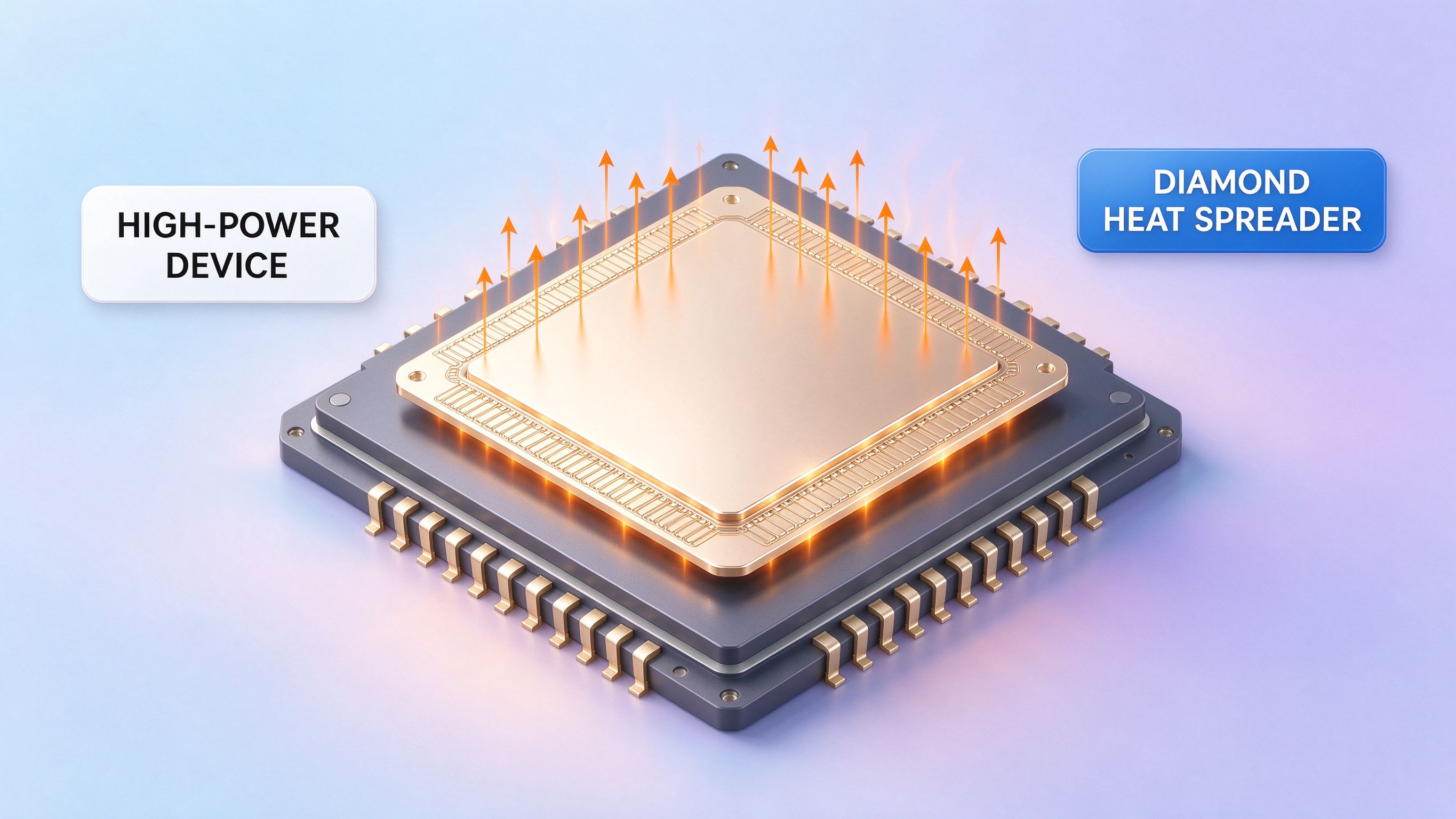
Heat-flux density in modern power electronics grows with every generation of chips, lasers and LEDs. When heat per square centimeter exceeds what common materials can handle, the question arises: switch to a more efficient material or enlarge the cooling area. Diamond —the most thermally conductive insulator—often looks attractive, but it costs more than copper and ceramics. This article is a practical guide: when diamond is truly justified, how to compare it with copper, silicon carbide and ceramics, and which decision algorithm to use.
⚠️ Conductivity values are reference material properties. Diamond is considered here as a heat-removal material (powder, composite, substrate); specific delivery forms and limits should be confirmed with the supplier. DIAMTECH supplies PCD-grade diamond micron powder (≤20 μm), used in thermal pastes and composites.
Why the Heat Problem Is Getting Worse
In three areas, heat-flux density has risen particularly fast. First is power electronics for EVs and inverters: IGBT and SiC modules run at high currents, dissipating tens and hundreds of watts over a small area. Second is laser diodes and optoelectronics: the emission zone is tiny, and specific heat reaches hundreds of W/cm². Third is high-power LEDs, where brightness degradation is directly tied to crystal overheating. In all these cases, heat must not only be removed but also spread from a small area onto a larger one before reaching the heat sink. This role —the "heat spreader"—is where diamond shines most.
Diamond vs Copper: When the Difference Matters
Copper is an excellent conductor of heat and electricity, but its conductivity (~400 W/m·K) is about 4–5 times lower than diamond. The difference becomes critical in two cases. First, very high heat-flux density: if power per unit area exceeds what copper can dissipate at the available thickness, copper simply cannot spread the heat fast enough and a local "hot spot" forms. Second, tight thickness and area limits: diamond can carry the same heat flux through a thinner layer or a smaller area. A practical rule: if you are limited by thickness or package size rather than cost, diamond is often the only working option.
Material Comparison Table
| Material | Conductivity, W/m·K | Electrical insulation | Cost | Best application |
|---|---|---|---|---|
| Diamond | 900–2300 | Yes (insulator) | High | Thin heat spreaders, hot spots, high-voltage modules |
| Copper | ~400 | No | Low | General heat sinks where insulation is not critical |
| SiC | ~120–490 | Yes | Medium | Semiconductor/substrate with high conductivity |
| AlN | 170–220 | Yes | Low–medium | Insulating substrates in electronics |
Key Selection Criteria
Five questions help make the decision. First, what is the heat-flux density? If it is above ~200–500 W/cm², diamond is worth serious consideration. Second, is electrical insulation needed? If yes and heat must be removed efficiently, diamond eliminates a separate insulating substrate. Third, is there a thickness or area limit? The tighter the limit, the stronger diamond's advantage. Fourth, what is the whole-system cost? Sometimes diamond costs more by itself but allows replacing a more expensive heat sink or shrinking the package, lowering total cost. Fifth, stability at operating temperature: diamond keeps its advantage from room temperature up to ~200–300 °C, typical for electronics.
Where Diamond Is Already Used
- Thermal pastes and composites for CPU/GPU, servers and gaming laptops —diamond micron powder as a highly conductive filler.
- Heat-sink substrates for laser diodes and optoelectronics, where flux density is maximal.
- Insulating thermal interfaces in inverter and converter power modules.
- High-voltage power electronics, where diamond both insulates and removes heat.
- Thermal pads in EV battery systems and 5G modules.
Two Ways to Use Diamond: Substrates and Micron Powder
In practice, diamond is used in two forms, and the choice depends on budget and project stage. The first is diamond substrates or films grown by CVD (chemical vapor deposition). This gives maximum conductivity and full control of properties, but at high cost and with limits on area and geometry; such products are justified in lasers, RF amplifiers and high-voltage modules where a critical task is solved. The second is diamond micron powder as a filler in thermal pastes, pads and composites. This is far cheaper, easier to integrate and needs no special equipment: you add the powder to an existing formulation. For most engineering tasks, especially at prototype stage, micron powder is a rational first entry point: it lets you measure the real effect without spending on CVD production.
A Practical Decision Algorithm
A recommended sequence: Step 1 —calculate or measure the heat-flux density and crystal temperature. Step 2 —determine whether you hit thickness, area or insulation limits. Step 3 —compare materials using the table above, considering whole-system cost, not just material. Step 4 —if you need above ~15–20 W/m·K in a thin interface, or hot spots that copper cannot solve —move to diamond. Step 5 —start with a trial batch: diamond micron powder is easy to test in your paste or composite before committing to substrates or CVD products.
Brief Conclusion
Diamond is not "always the best" material, but optimal under specific conditions: high heat-flux density, tight thickness/area limits, and the need for electrical insulation. Where these conditions are absent, copper or ceramics remain a rational cost choice. Diamond's key value is removing the "hot spot" and spreading heat from a small area that other materials cannot handle. For thermal pastes and composites, diamond micron powder is the most accessible way to use this advantage. We supply PCD-grade diamond micron powder (≤20 μm) with controlled purity and particle-size distribution; a trial batch from 1 kg will help you verify it in your cooling system.
Testing diamond in your cooling system?
PCD grade ≤20 μm, purity ≥99.9%, D10/D50/D90 certificate. Trial batch from 1 kg.
Request a trial batch and a quote