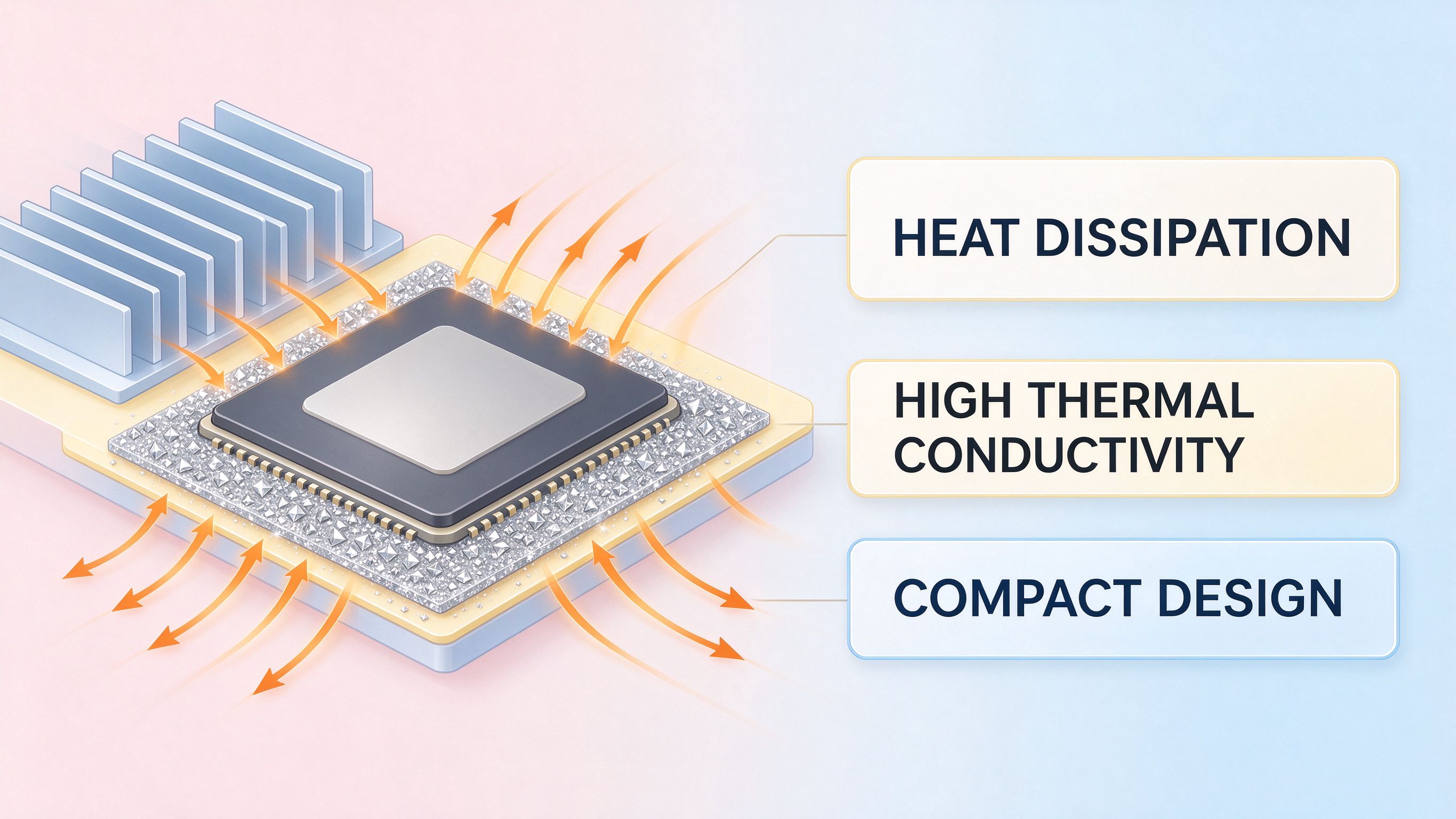
As electronic components grow in power and packages get denser, heat removal becomes the central engineering problem. At its heart is the thermal interface material (TIM): a thin layer between chip and heat sink that fills micro-roughness and transfers heat. Its efficiency depends on the filler. Diamond micron powder is the only filler whose thermal conductivity is an order of magnitude higher than traditional ceramics —available in narrow fractions from single to tens of micrometers. In this article we break down why diamond beats alumina, aluminum nitride and boron nitride, how grain size and purity affect real thermal conductivity, and when micron powder makes sense in your thermal solution.
⚠️ DIAMTECH supplies PCD-grade diamond micron powder (≤20 μm) —exactly the range used in high-performance thermal pastes and polymer compounds. Thermal conductivity values in this article are reference material properties, not characteristics of a specific batch.
How a Filler Conducts Heat in a Polymer Matrix
Polymers (silicone, epoxy) barely conduct heat themselves —around 0.2 W/m·K. To get a working TIM, a highly conductive filler is added. But the filler does not work "as is": heat in a composite travels along contact chains between particles. While particles are few and do not touch, the composite conducts poorly. The turning point is the percolation threshold: once the filler volume fraction exceeds a certain level, particles form a continuous network and conductivity rises sharply.
The filler's thermal conductivity is only one factor. Equally important are particle shape, size distribution, and surface wetting by the polymer. Sharp or platelet particles form contacts better but flow worse during application. Spherical particles lower paste viscosity but require higher loading for percolation. Here diamond micron powder offers a unique advantage: its own thermal conductivity is so high that even at moderate loading, a network of diamond grains transfers heat incomparably better than an alumina network at the same volume fraction.
Why Diamond Outperforms Ceramic Fillers
| Filler | Thermal conductivity, W/m·K | Electrical insulator? | Cost/availability |
|---|---|---|---|
| Diamond | 900–2000 | No (conducts heat, not electricity) | High, but justified for top-tier solutions |
| AlN | 170–220 | Yes | Medium |
| BN (hexagonal) | ~300 (in-plane) | Yes | Medium |
| Al2O3 | 25–35 | Yes | Low |
The main limit of ceramics is their thermal conductivity tens of times lower than diamond. Even at extreme loading (60–80% by volume), an Al2O3 composite rarely exceeds 6–8 W/m·K. Aluminum nitride gives 10–15 W/m·K but costs more than alumina and is moisture-sensitive. Diamond at the same loading can deliver 20–40 W/m·K and beyond, if the particle network is built correctly. That is why in premium pastes for gaming laptops, servers and EVs, diamond micron powder is used either as the main filler or as an additive that strengthens the network of cheaper particles.
How Grain Size Affects Thermal Conductivity
In the micron range, grain size directly affects the result. In very fine grains (submicron), phonon scattering at grain boundaries rises and the particle's own conductivity drops. Practically, grains from 5 μm and above work better for a conductive filler, where diamond's bulk conductivity is near full. But large grains have a downside —they increase the bond-line thickness between chip and heat sink and fill micro-roughness worse. The compromise used by paste makers: bi- or tri-modal distribution, where coarse grains (10–40 μm) build the network skeleton and fine grains (1–5 μm) fill voids between them, raising total loading without growing viscosity.
Why Purity and Narrow Distribution Matter
In a thermally conductive composite, impurities act as extra scattering centers. Iron, nickel, cobalt —residues of diamond synthesis catalysts—disrupt phonon transport and reduce effective conductivity. So high purity (usually ≥99.9%) is critical for a TIM filler. Equally important is a narrow size distribution: a wide D90/D10 spread means coarse and fine grains do not pack optimally, and part of the filler volume does not contribute to the network. A certificate with D10, D50, D90 is a mandatory requirement for any micron powder supplier for thermal interfaces.
Where Diamond Micron Powder Is Used in Thermal Interfaces
- Thermal pastes for CPU/GPU and gaming laptops —premium segment with high loading
- Thermal pads for power electronics and EV batteries
- Potting compounds for 5G and telecom modules
- Laser diode and optoelectronic thermal interfaces
- Additive in compounds for high-power LED lighting
Practical Choice: When Diamond Is Justified
Diamond micron powder costs more than ceramic fillers, so it is used selectively —where conductivity requirements are unreachable by other means, or where price solves a problem at the system level (e.g., replacing a more expensive heat sink). If your goal is to push TIM conductivity above 15–20 W/m·K at reasonable viscosity, diamond is practically the only path. If 3–5 W/m·K is enough, alumina suffices. A rational approach is a bi-modal blend: a coarse diamond fraction for the network plus inexpensive AlN or Al2O3 to fill voids, cutting cost while keeping target conductivity.
Brief Conclusion
Diamond micron powder is the most effective available filler for thermal interfaces: its conductivity is an order of magnitude above ceramics, and narrow fractions plus high purity allow building working thermal networks even at moderate loading. Key decisions are grain size (bi-modal packing), purity (≥99.9%) and a D10/D50/D90 certificate. If the goal is above 15–20 W/m·K in a thin interface, diamond is practically without alternative. We supply PCD-grade diamond micron powder (≤20 μm) with controlled purity and particle-size distribution; start with a trial batch from 1 kg to check behavior in your polymer compound.
Need diamond micron powder for your thermal interface?
PCD grade ≤20 μm, purity ≥99.9%, D10/D50/D90 certificate. Trial batch from 1 kg.
Request a trial batch and a quote