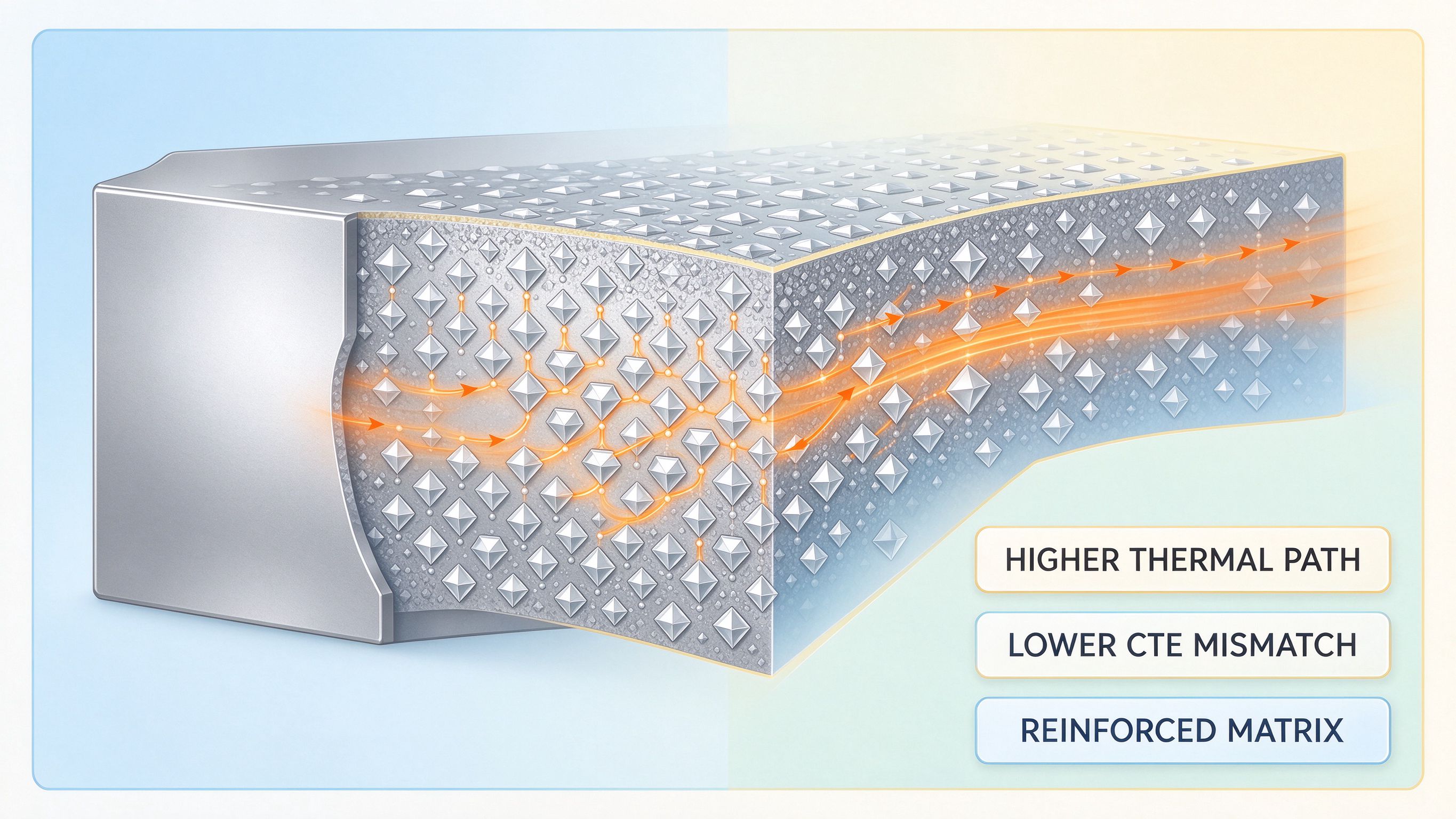
Metal and ceramic composites with diamond filler promise thermal conductivity unreachable for pure metals and ceramics. But in practice diamond's high conductivity rarely "arrives" at the part: the gap between ideal calculation and real composite conductivity almost always hides in two places —the interface between diamond and matrix, and particle packing. In this article we explain how micron powder becomes a working conductive matrix, why without a carbide-forming coating high numbers stay on paper, and which powder parameters dictate the final conductivity.
⚠️ This article is a technical review of principles for building high-conductivity diamond-filled composites. DIAMTECH supplies PCD-grade micron powder (≤20 μm) and coarse fractions on request; specific matrix and coating compositions are a matter of your own technology.
From Diamond Filler to Matrix: The Role of Interface
Diamond is chemically inert: neither copper, aluminum, nor most ceramics wet its surface. When heat must pass from matrix into a diamond grain, a thermal resistance appears at the non-wetted boundary. The higher the diamond volume fraction, the larger the area of such "dead" boundaries —and without intervention the filler's high conductivity does not work. The solution is an interlayer: carbide-forming metals (Ti, Cr, W, Zr) coated on the diamond surface form a thin carbide (TiC, Cr3C2, WC) upon annealing, chemically bonded to diamond on one side and well-wetted by the matrix on the other. Typical thickness is 200 nm to 1 μm. It is this layer that turns scattered grains into a continuous conductive network.
Particle Packing: Why Shape and Distribution Decide
Composite conductivity depends not only on diamond fraction but on how particles pack. Well-shaped, near-spherical grains pack more densely and allow a high diamond fraction without rising residual porosity. Sharp flaky particles cause interlocking, raise porosity and lengthen roundabout heat paths. So composites call for not just a size but a narrow distribution with selected shape. A common practice is a bi-modal blend: coarse grains build the skeleton, fine grains fill gaps, pushing total diamond share above what one fraction yields. For a supplier this means controlling not only the median size D50 but the upper end of the distribution D90.
Powder Parameters That Dictate Conductivity
| Parameter | Effect |
|---|---|
| D50 / fraction range | Sets bond-line thickness and packing; narrow range = predictable network |
| Grain shape | Spherical/rounded packs denser, lower porosity |
| Purity | Metallic impurities = scattering centers; target ≥99.9% |
| Coating (Ti/Cr/W) | Required for wetting; thickness 200 nm–1 μm |
Matrix Formation Methods
| Method | Advantages | Limitations |
|---|---|---|
| High pressure (HPHT) | High density, diamond skeleton | High cost, complex shapes limited |
| Melt infiltration | Near-full density, high conductivity | Complex equipment |
| Spark plasma sintering (SPS) | Fast cycle, fine grain, high density | Limited part size |
Why Micron Powder, Not Just Coarse Fractions
Although metal heat sinks traditionally use coarse fractions (50–300 μm), micron powder plays its own role. First, in thin conductive coatings and interfaces micro-particles allow a working layer tens of micrometers thick, where coarse grains simply do not fit. Second, fine fractions fill gaps between coarse grains in bi-modal packing, raising total diamond share. Third, some processes (e.g., printing or slip casting) need a flowable suspension, easier with micron powder. Practical takeaway: coarse and micro fractions are both needed in one recipe, and their ratio is part of the conductivity engineering calculation.
Practical Powder Requirements for Composites
Not every diamond powder suits composites. The key is predictability: if carbide layer thickness and composition drift batch to batch, the technologist cannot reproduce conductivity. Before launching series work, ask the supplier for: a particle-size certificate with D10/D50/D90, grain-shape data, purity level, and a coating report. The first step is a trial batch from 1 kg, on which both wettability and powder behavior in your sintering cycle are checked. For mass production, lock the recipe and source batch so the fifth shipment repeats the first trial.
Brief Conclusion
A high-conductivity matrix from diamond powder rests on three pillars: a carbide-forming coating for wetting, thoughtful (bi-modal) packing, and predictable powder parameters (D50/D90, shape, purity). Without an interface layer, even the highest diamond fraction gives no expected conductivity; without a narrow distribution, part of the filler does not join the network. We supply PCD-grade micron powder and coarse fractions with controlled purity and particle-size distribution, backing batches with a report. Start with a trial batch from 1 kg to check powder behavior on your route.
Need diamond powder for your composites?
PCD grade ≤20 μm and coarse fractions, purity ≥99.9%, D10/D50/D90 certificate. Trial batch from 1 kg.
Request a trial batch and a quote