Tungsten carbide (WC-Co) hard metals are one of the most common materials for cutting tools, dies, and wear parts. Their hardness (88–93 HRA, 1300–1800 HV) makes processing with conventional abrasives (SiC, Al₂O₃) inefficient — diamond is the only abrasive that is economically viable for carbide processing. But wrong diamond powder selection leads to edge chipping, low productivity, and powder waste.
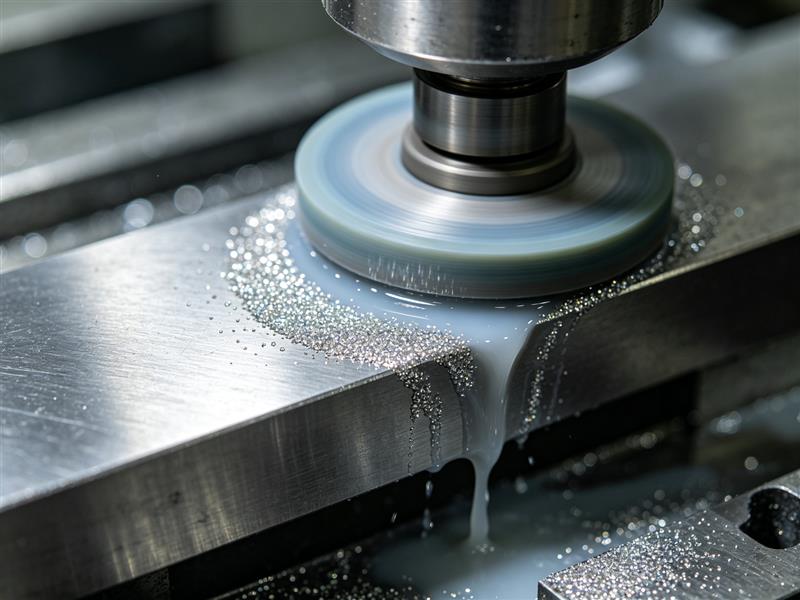
Why Carbide Is a Special Material
WC-Co consists of two phases with completely different properties:
- WC (tungsten carbide) — hard phase, hardness ~2500 HV, brittle, prone to chipping under impact loads.
- Co (cobalt) — ductile binder, hardness ~200 HV, plastic, "lubricates" cutting. Cobalt content usually 6–15%.
Due to the two-phase structure, carbide processing has specifics: too aggressive abrasive (large sharp-edged grains) causes WC grain pull-out, too soft abrasive wears quickly against the cobalt binder. The optimal diamond powder should provide micro-brittle fracture of WC without macroscopic chipping.
Grain Size Selection by Operation
| Operation | Grain size | Ra roughness | Grain shape |
|---|---|---|---|
| Rough grinding (0.1–0.5 mm stock removal) | W28–W40 | 1.6–3.2 μm | Sharp-edged/intermediate |
| Finish grinding (0.02–0.1 mm stock) | W14–W20 | 0.4–0.8 μm | Intermediate |
| Pre-polishing (lapping) | W7–W10 | 0.1–0.2 μm | Spherical A/B |
| Final polishing (mirror) | W1–W5 | 0.01–0.05 μm | Spherical AA/AAA |
| Cutting tool sharpening | W10–W20 | 0.2–0.4 μm | Spherical A/intermediate |
Grain Shape: Critical Parameter for Carbides
Sharp-Edged Grains — for Rough Grinding
Sharp-edged grains have pronounced cutting edges and provide high material removal rates. But for carbides they have a significant drawback: upon contact with the WC phase, sharp edges cause macroscopic chipping of tungsten carbide, especially on cutting edges. This leads to reduced tool life and the need for additional lapping.
Spherical Grains — for Finishing and Polishing
Spherical (isometric) grains have no sharp edges and work on the principle of micro-brittle fracture: they gradually chip microscopic WC particles without macro-chipping. This provides:
- No chipping on cutting edges and surfaces
- Low surface roughness already after grinding
- 30–50% reduction in polishing time
Disadvantage of spherical grains — lower removal rate (20–30% compared to sharp-edged). Therefore using them for rough grinding is not economical.
Powder Concentration in Slurries and Pastes
Diamond powder concentration in the working medium affects productivity and consumption. Optimal concentration depends on the processing method:
| Method | Concentration | Carrier |
|---|---|---|
| Lapping on cast iron plate | 3–8 ct/L (0.6–1.6 g/L) | Water + surfactant |
| Polishing on felt/foam | 1–5 ct/L (0.2–1.0 g/L) | Water/oil |
| Diamond paste | 5–30% by weight | Vaseline/PEG/silicone |
| Machine slurry | 0.5–2 ct/L (0.1–0.4 g/L) | Water + lubricant |
Common Mistakes
- Using sharp-edged powder for polishing — leads to deep scratches that cannot be removed by subsequent polishing. For carbide polishing, always use spherical grade AA/AAA powder.
- Too high concentration — many think "more powder = faster". In reality, above optimal concentration, grains start colliding with each other, some break uselessly, and consumption increases without productivity gain.
- Skipping intermediate grain sizes — jumping from W20 directly to W3 for polishing. Deep scratches from W20 are not removed by W3, requiring 3–5 times more time. Correct sequence: W20 → W10 → W5 → W3 → W1.
- Ignoring cobalt content — high-Co alloys (12–15%) are more ductile and require more spherical powder and lower concentration. Low-Co alloys (6–8%) are more brittle and tolerate more aggressive powder.
Typical WC-Co Grinding Parameters on Diamond Wheels
Powder is only one side of the process. To achieve stable results, it is important to match diamond grain size with the wheel bond and machining regime. Below are typical parameters for surface grinding tungsten carbide on a peripheral wheel:
| Operation | Wheel speed | Table feed | Depth per pass | Wheel bond |
|---|---|---|---|---|
| Rough (W28–W40) | 25–30 m/s | 8–15 m/min | 0.01–0.025 mm | Metal (M) |
| Finish (W10–W20) | 20–25 m/s | 5–10 m/min | 0.005–0.01 mm | Rubber/resin (B/R) |
| Lapping (W5–W7) | 15–20 m/s | 3–6 m/min | 0.002–0.005 mm | Metal (soft) |
| Polishing (W1–W3) | 10–15 m/s | 2–4 m/min | 0.001–0.002 mm | Resin/polyurethane |
Wheel speed is a critical parameter. Above 35 m/s when grinding WC-Co, thermal damage to the surface layer occurs (dark tempering areas, microcracks) that are invisible to the eye but reduce tool strength by 30–50%. For high-cobalt carbides (12–15%), reduce speed by 5 m/s from the table above.
Coolant for Carbide Grinding
WC-Co is temperature-sensitive, so cooling must be abundant and correctly selected:
- Synthetic water-soluble coolant at 5–8% concentration — universal choice. Provides good cooling and chip flushing. Avoid chlorine-containing additives — they cause pitting corrosion of the cobalt binder.
- Flow rate: at least 15–20 L/min to the cutting zone. The jet must be aimed precisely at the wheel-workpiece contact point, not "at the general area".
- Coolant temperature: 18–25°C. Overheated coolant (above 30°C) loses lubricating ability and accelerates wheel wear.
Grinding Troubleshooting
| Symptom | Likely cause | Solution |
|---|---|---|
| Deep scratches on surface | Large particles in slurry, contamination, wrong grain size | Filter slurry, switch to finer W, check powder D90 |
| Burn marks (dark spots) | High speed, insufficient coolant, dull wheel | Reduce speed, increase coolant, dress wheel |
| Rapid wheel wear | Bond too soft, low concentration, low diamond TI | Switch to harder bond, increase concentration, verify TI ≥ 60% |
| Wheel glazing | Bond too hard, TI too high, too small depth | Softer bond, RVD powder, increase depth per pass |
Wheel Bond Selection for Different Carbide Grades
Bond selection is no less important than grain size. General rule: the harder the carbide being machined, the softer the bond should be (to expose new grains in time), and vice versa. Guideline recommendations for typical grades:
| WC-Co grade | Co content | Recommended bond | Grain size |
|---|---|---|---|
| YG6 (HK15) | 6% | Soft metal / resin | W20–W40 |
| YG8 (HK12) | 8% | Medium metal | W14–W28 |
| YG15 (HK10) | 15% | Hard metal | W10–W20 |
| YT15 (with TiC) | 6% Co + TiC | Very soft metal | W20–W40 |
TiC-added grades (YT series) are even harder and more brittle than pure WC-Co, requiring even softer bond and a 10–15% reduction in cutting speed. Ignoring this leads to rapid wheel glazing and cutting edge burning.
Practical conclusion: for carbide processing, always use a staged approach — rough grinding with sharp-edged W28-W40, finishing with intermediate W14-W20, polishing with spherical W1-W10. This provides the optimal balance of productivity and surface quality.
Wheel Bond and Powder Selection
Diamond powder choice for a grinding wheel is driven first by the bond type. The bond holds grains and sets the self-sharpening behavior.
- Resin bond — needs friable coated powder; easy grain pull-out = self-sharpening.
- Metal bond — needs blocky high-TI powder, wear retention.
- Vitrified — fine powder, stable geometry.
Diamond Concentration in the Wheel
Diamond concentration (by industry convention 100% = 4.4 ct/cm³) sets the number of active grains per unit area. Higher concentration means longer life but more heat and higher cost; lower means more aggressive removal but faster bond wear. Concentration is matched to wheel speed (typically 20–35 m/s) and coolant flow: at high speed a stronger bond and high-TI powder are needed so grains are not pulled out prematurely.
Wheel Truing and Cooling
Even a correctly chosen powder cannot show its potential without proper truing and coolant. Periodic truing (diamond roller or pencil) restores geometry and exposes fresh grains, sustaining self-sharpening. Cooling (water-based coolant, 8–15% emulsion concentration) removes heat and flushes swarf; without it, carbide burns and diamond graphitizes at the cutting edge. Wheel speed 20–35 m/s is the working range for most VK/HM operations.