When purchasing diamond micron powder, Russian customers encounter several marking systems: GOST 9206-80 (Soviet/Russian standard), GB/T 35477-2017 (Chinese national standard) and the ISO 13320:2020 control method (laser diffraction). Although all systems describe the same product, there are important differences in measurement methods, tolerances and marking. Understanding these differences helps avoid purchasing errors and ensures powder meets production requirements.
Grain size correspondence table
GOST main marking uses ACM (diamond micron powder) designation with grain size number (4, 6, 10, 20, 40...), where the number indicates maximum grain size in micrometers. ISO uses a similar system with D-number designations. Virtually all modern manufacturers, including us, use unified W marking (W5, W10, W20...), compatible with both systems.
Key differences
1. Measurement method
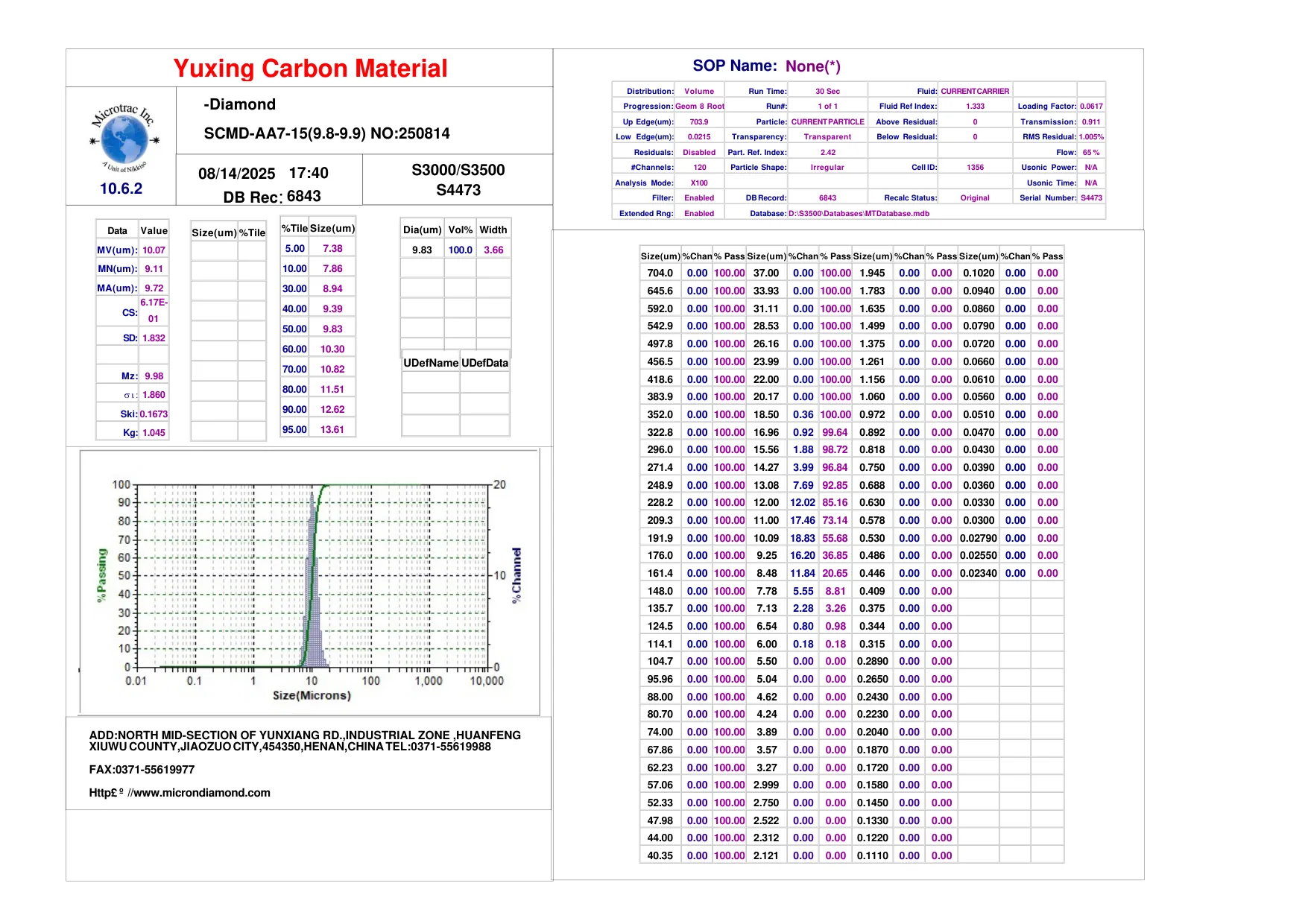
GOST 9206-80 traditionally uses sieve and microscopic methods for grain size control. The international standard ISO 13320:2020 specifies the laser diffraction method (laser granulometer), which is more accurate and reproducible. The Chinese standard GB/T 6406-2016 also allows laser diffraction. We control every batch on a Malvern Mastersizer laser granulometer and can provide reports compatible with both standards.
2. Coarse grain content tolerances
GOST stricter limits content of grains larger than nominal size (no more than 1% for most grain sizes). ISO allows up to 3% coarse grains. In practice, our powders meet the stricter GOST requirements for coarse grain content, which is especially important for PCD sintering where even single coarse grains can cause defects.
3. Package marking
GOST requires detailed marking: company name, batch number, grain size, weight, manufacturing date, quality certificate. ISO has more flexible marking requirements. We mark every package according to GOST requirements, including batch number and date, allowing traceability of any batch at all stages.
Practical conclusion: if you operate in the Russian market and your production requires GOST compliance, inform us when ordering. We will provide powder with GOST quality certificate and laser granulometer report.
Practical tip
For a first purchase we recommend a trial batch from 1 kg: test the fraction on your equipment before a bulk order. Every trial batch comes with a report (particle size, Fe+Ni+Co). Standard W5/W10/W20 fractions are always in stock — ships within 48 hours.
Complete Conversion Table: China W / International / Japanese Mesh
Below is the complete grain size marking conversion table (excerpt of most commonly used fractions):
| China W | D50 (μm) | International | Japanese (mesh) |
|---|---|---|---|
| W5 | 4.5–5.4 | 4–6 | 3500 |
| W7 | 5.4–6.8 | 4–8 | 3000 |
| W10 | 7.5–8.6 | 6–12 | 1800 |
| W14 | 10.5–12.0 | 8–16 | 1300 |
| W20 | 15.5–17.6 | 12–22 | 850 |
| W28 | 20.5–25.5 | 20–30 | 700 |
| W40 | 29.5–35.5 | 30–40 | 450 |
The complete table includes 30 fractions from W0.2 (0.09–0.11 μm) to W50+ (45–51 μm). When requesting pricing, always specify the exact D50 range, not just the W mark.
The Key Distinction: Product Standard vs Test Method
A common ordering mistake is mixing product standards with test-method standards. GOST 9206-80 and GB/T 35477-2017 are product documents: they define what the powder should be (grades, grain sizes, impurity limits, packaging and marking). ISO 13320:2020 is a control method: it defines no product grades but specifies how particle size distribution is measured by laser diffraction. So a correct order reads: "powder per GB/T 35477-2017, particle-size control per ISO 13320:2020" — this removes most misunderstandings with the supplier.
Why the Method Changes the Numbers
The sieve and microscopic methods built into GOST 9206-80 judge a particle by its largest linear dimension. Laser diffraction per ISO 13320:2020 reports an equivalent spherical diameter — for the same powder, D50 can differ by 5–15% depending on grain shape. That is why you cannot directly compare a "sieve" D50 from an old report with a "laser" D50 from a new one: the numbers differ because the method differs, not because the powder changed. Fix the measurement method and the volume basis in the contract.
Marking Correspondence: ACM and W
In the GOST system, micron powder is designated ACM (synthetic diamond micron powder) with a grain-size number near the upper bound of the fraction. The Chinese system uses W marking with a number near the same upper bound at the D50 level. In practice, the GOST alphanumeric mark and the W mark are not strictly identical, so for a first order rely on the numeric D50 range from the laser report rather than on the index. We supply powder to the D50 range you specify and accompany every batch with a report.
Frequently Asked Questions
Do I need to require GOST compliance if I resell the powder?
If your end customer works under GOST, require a quality certificate and marking per GOST 9206-80. If you use the powder in your own process, it suffices that the actual D50 and impurities meet your technical specification; fix the control method (ISO 13320:2020) in the contract.
Why does the same W10 give different results from different suppliers?
Because fraction boundaries differ between producers: some hold D50 near 7.5 μm, others near 9 μm. The same W index does not guarantee the same D50. Compare the numeric D10/D50/D90 from the report, not the mark.
Can I get a report that suits both GOST and ISO?
Yes. We measure every batch on a laser granulometer per ISO 13320:2020 and issue a quality certificate. If an official report per the Chinese standard GB/T 6406-2016 is required, we provide an accredited laboratory report on request.
Quick Tips for the Russian Buyer
- In the inquiry state not only the W mark but the D50 range, allowed coarse-grain content and impurities.
- Fix the control method: particle size per ISO 13320:2020, and a GOST 9206-80 quality certificate if required.
- Accept the first batch against the report: verify D10/D50/D90 against declared values.
- A trial batch from 1 kg and stock fractions W5/W10/W20 (48h dispatch) let you verify compliance quickly before a bulk order.
Summary: Which Standard Goes Where
| Document | Type | Region | What it defines |
|---|---|---|---|
| GOST 9206-80 | Product | Russia / EAEU | Grades, grain sizes, impurity limits, packaging |
| GB/T 35477-2017 | Product | China | Technical conditions for synthetic diamond |
| ISO 13320:2020 | Method | International | Laser diffraction — particle size measurement |
| GB/T 6406-2016 | Method | China | Superabrasive grain size control |
A well-written inquiry combines a product standard with a control method: e.g. "micron powder per GB/T 35477-2017, D50 in the 7.5–8.6 μm range, report per ISO 13320:2020". If your process follows Russian norms, add a requirement for a GOST 9206-80 quality certificate. This removes ambiguity and lets you accept each batch on objective numbers rather than on the brand of the mark. Send us your specification — we will prepare an offer stating the standards applied and a sample report.
A Common Acceptance Mistake
Batches are often rejected because new report numbers do not match an old familiar value. Before rejecting the powder, check the measurement method: if the old report was sieve-based and the new one is laser per ISO 13320:2020, a 5–15% gap is normal and does not mean lower quality. Fix one control method for the whole contract term — otherwise the comparison is invalid.
Product inquiry
Fill in 4 fields — we reply within 1 business day. Or message us directly on VK / MAX.
Request a quote