What Happened
On October 9, 2025, China's Ministry of Commerce and General Administration of Customs jointly issued Announcement No. 55 "On Implementing Export Controls on Superhard Materials." The document took legal effect on November 8, 2025. This is an official state policy act based on China's Export Control Law, Foreign Trade Law, and Regulations on Export Control of Dual-Use Items.
What Exactly Is Controlled
Announcement No. 55 introduces export licensing for the following categories of superhard materials:
| Code | Item Name | Technical Parameters | Status |
|---|---|---|---|
| 2C902.a | Diamond Micron Powder | D50 ≤ 50 μm | License Required |
| 2C902.b | Diamond Single Crystal | 50 μm < D ≤ 500 μm | License Required |
| — | Diamond Wire Saw | Wire ≤ 45μm, grain ≤ 8μm | License Required |
| — | Diamond Grinding Wheel | Specific characteristics | License Required |
Important clarification: lab-grown diamonds for jewelry and decorative purposes are NOT covered by this announcement. The control applies exclusively to industrial diamonds.
How This Affects Your Business
With Announcement No. 55 taking effect, direct export of diamond micron powder as raw material from China has become impossible without a special license. This means:
- Raw material (micron powder W0.5–W50) — direct export is blocked. A dual-use export license is required, processing takes 30–90 days, and approval is not guaranteed.
- Payment for raw materials — banks and payment systems exercise heightened scrutiny on dual-use item transactions. Transfers may be delayed or rejected.
- Customs clearance — customs may request additional documents and suspend goods release upon any doubts about the declaration.
DIAMTECH's Solution: Transitioning to Semi-Finished and Finished Products
To ensure supply continuity for our customers, DIAMTECH has adjusted its business model. We no longer accept orders for raw material (diamond micron powder as a standalone product). Instead, we offer:
| Product | Description | Status |
|---|---|---|
| PCD Composite (semi-finished) | Finished PCD blanks for cutting tools and drills, sintered from micron powder | Available |
| PDC Drill Bits (finished) | Finished drill bits for mining and oil & gas | Custom Order |
| Diamond Paste (finished) | Ready-to-use polishing compound based on micron powder | Available |
| Diamond-coated Tools | Finished cutting and grinding tools | Custom Order |
| Diamond Micron Powder (raw) | Direct export restricted, license not guaranteed | Not Available |
Why Semi-Finished Products Benefit You
Transitioning to semi-finished products not only solves the export control problem but also offers additional advantages:
- Production-ready — PCD blanks are already sintered and ready for machining. You don't need to invest in sintering equipment and powder quality control.
- Quality stability — we control quality at every stage: from raw material selection to sintering. Every batch undergoes laser particle size analysis and strength testing.
- Reduced logistics — semi-finished products have higher added value at the same weight, reducing delivery cost per unit of final product.
- Technical support — our engineers will help select the right PCD grade for your production and provide machining recommendations.
What Existing Customers Should Do
If you have active raw material orders or long-term contracts:
- Contact us — email yy3034@foxmail.com or WhatsApp/VK to discuss replacement options.
- Consider PCD blanks — if you used micron powder for PCD sintering, we can supply finished blanks at competitive prices.
- Order a trial batch — we provide PCD blank trial batches from 1 kg for testing on your equipment.
- Plan the transition — we recommend transitioning to semi-finished products within the next 3 months to avoid supply disruptions.
Why the 50 μm Threshold — Technical Explanation
Dual-use material categorization always relies on a technical criterion, not an arbitrary decision. The D50 ≤ 50 μm threshold for diamond powder is based on the fact that it is the ultra-fine diamond powder that is the key raw material for PCD/PDC, semiconductor materials and precision optics — products with both civilian and potential military applications. Coarser fractions (e.g., 60/80 mesh ≈ 200–250 μm for stone-cutting segments) are not used in high-tech critical applications and therefore are not subject to licensing.
An additional criterion is mono-/polycrystallinity and morphology. The control primarily covers monocrystalline synthetic diamond produced by the HPHT method. CVD diamond (used in electronics and optics) is regulated separately and does not always overlap with this announcement. Exact classification under codes 2C902.a and 2C902.b must be confirmed with the exporter and customs broker.
Export License Application Process: Overview
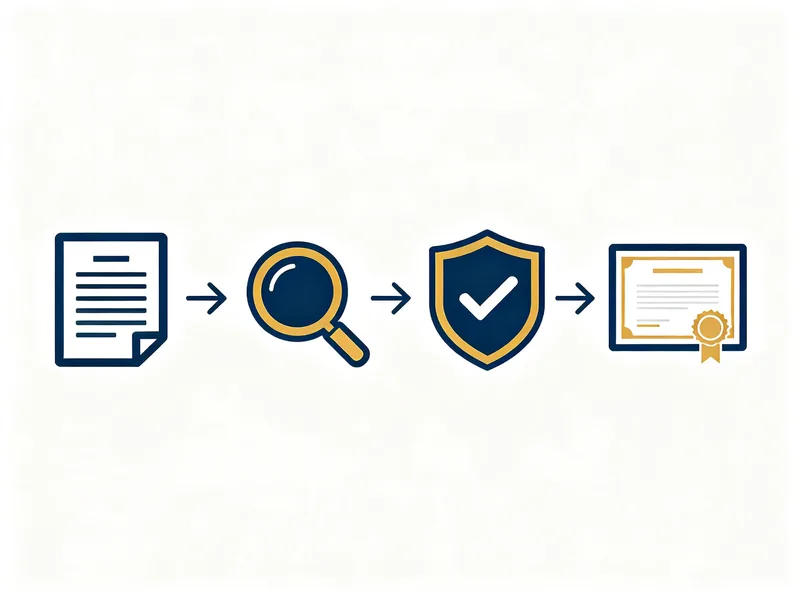
For exporters wishing to maintain direct micron powder shipments, the license application procedure is as follows (simplified):
- Submitting an application to China's Ministry of Commerce with product description, technical parameters, consignee and end use.
- Screening the consignee against the entity list and assessing diversion (dual-use) risks.
- Technical review (if needed) — verifying that the product parameters actually fall under regulation.
- License issuance (upon approval) valid for 6–12 months for a specific batch or series.
Processing time is typically 30–90 calendar days. Approval probability depends on the consignee's reputation, end-use transparency, and the exporter's track record. The first licensed contract almost always undergoes stricter review than subsequent ones.
Questions to Ask Your Supplier Before Ordering
- "Which 2C902.a/b codes does your powder fall under?" — to understand if a license is needed at all.
- "What is your plan B if the license is not approved?" — a serious supplier will offer PCD blanks or pastes as an alternative.
- "Can you provide a COA with confirmed D50 and impurity content?" — so customs can classify the goods.
- "Are you willing to work under a semi-finished scheme (PCD blanks, pastes, tools)?" — this bypasses raw material licensing.
What Changed for Buyers in Russia After November 8, 2025
For Russian and Belarusian buyers, this practically means a shift from the model "ordered micron powder → received in 2 weeks" to the model "work through finished forms (PCD blanks, pastes, tools)". Direct import of raw micron powder (W0.5–W50) now requires not only a Chinese export license but also heightened attention from banks and payment systems. Payments under contracts with dual-use items may undergo additional compliance review for 3–10 banking days. This does not mean shipments are completely stopped — serious exporters are working on licensed routes, but timelines and cost have increased. Transition to PCD blanks and pastes remains the most predictable route under current conditions.
Practical conclusion: export control is the new reality for the entire industry. Companies that quickly adapt to semi-finished product supply will gain a competitive advantage. DIAMTECH is ready to help you at every stage of the transition.
Need Consultation on Raw Material Replacement?
Our engineers will help select a semi-finished equivalent and calculate the transition economics. We'll respond within 24 hours.
Contact UsWhy Diamond Micron Powder Falls Under Export Control
Synthetic diamond micron powder is a universal abrasive, but in several jurisdictions it is classified as a strategic good due to potential dual-use. In the EAEU it falls under HS code 7105 10 000 0 (diamond powder). This means border crossing may require declaration and licensing procedures depending on grain size and destination country.
This page is informational, not legal advice. Confirm current documentation and licensing requirements with the customs authority or an accredited broker before every shipment.