One of the most common causes of diamond micron powder shipments being delayed at Russian customs is confusion between China's export control and EAEU technical regulation. Russian buyers often ask: "Is an EAC declaration required, and who prepares it — us or the Chinese supplier?" Below is an explanation without legal commitments, with "confirm with your customs broker" notes.
1. What an EAC Declaration of Conformity Is
An EAC Declaration of Conformity is a document of the EAEU unified technical regulation system confirming that a product meets the requirements of the relevant technical regulation (TR CU/EAEU). It is based on test protocols and registered in the unified register of the Russian Federal Accreditation Service. A declaration is lighter than a certificate: the applicant is typically the importer or an authorised representative within the EAEU, and the applicant bears responsibility for the accuracy of the data.
The key difference from a certificate: under certification the accredited body is responsible for conformity; under declaration the applicant is. For most abrasive materials and bulk industrial powders, a declaration — not a certificate — applies.
2. Does Diamond Micron Powder Fall Under Declaration
Diamond micron powder is classified under EAEU HS code 7105 10 000 0 (diamond powder). Under current EAEU technical-regulation practice, synthetic diamond powders fall under a Declaration of Conformity rather than mandatory certification. The specific technical regulation and the need for a declaration depend on the declared purpose of the goods (abrasive material, component for tooling, etc.).
The exact list of regulations and whether a declaration is required for your intended use should be confirmed with your Russian customs broker — classifications and requirements can change.

3. Documents Needed for Import to Russia
For customs clearance of a diamond micron powder batch, the following basic document set is typically required (may be extended):
- EAC Declaration of Conformity (registered in the Russian register)
- Foreign-trade contract (supply agreement)
- Commercial invoice and packing list
- Certificate of origin (where required)
- Test / analysis protocols (CoA, particle-size and impurity data)
4. Who Prepares the Declaration and Its Validity
The applicant for the declaration must be an entity registered in the EAEU — the Russian importer or its authorised representative. The Chinese exporter can prepare the technical basis (protocols, product description), but registration in the Russian register must be done by the EAEU-side applicant. The declaration's validity period is set by the regulation and is typically up to 5 years for serial supplies (exact period per applicable regulation).
5. Consequences of Missing the Declaration
Without a registered declaration, goods subject to the technical regulation are not released by customs: the batch may be held at a temporary storage warehouse, administrative fines may apply, and in the worst case the cargo is returned to the sender. It is simpler to prepare the declaration before shipment than to fix missing documents at the border.
6. Common Misconceptions
Must the EAC mark be on the package
The EAC mark is applied to the product and/or accompanying documents where the regulation provides. For bulk abrasive powders the mark is more often shown in accompanying documents; requirements for marking the package itself should be confirmed with your broker.
Can one declaration cover several specifications
A declaration is tied to the declared characteristics and intended use. Different grit classes or purposes (e.g., abrasive powder vs. a PCD component) may require separate declarations or an extension. Confirm the coverage for your range with a compliance specialist.
7. Relation to China's Export Control
It is important to distinguish two independent systems: the EAC declaration is an EAEU requirement for market access, while a dual-use export license is a China requirement for export. A declaration does not replace an export license, and vice versa. A batch may simultaneously require a Chinese export license (under dual-use regulation) and a Russian EAC declaration. Plan both documents in advance.
8. Declaration Types: Batch vs Serial
The EAEU distinguishes two main declaration schemes, and the choice between them significantly affects timelines and cost:
| Scheme | Scope | Validity | When to use |
|---|---|---|---|
| Per batch (1C) | One specific batch | Unlimited (for this batch) | One-off shipments, trial orders |
| Serial (2C/3C) | All shipments within validity | Up to 1–5 years | Regular orders, stable SKU range |
For regular diamond micron powder buyers, a serial declaration is more cost-effective: it is issued once and covers all subsequent shipments within the declared characteristics (grain size, intended use). A per-batch declaration is faster to issue (3–7 business days vs. 15–30 for serial) but must be repeated for every shipment.
9. What a Test Report for Declaration Must Contain
The basis for registration is test reports issued by an accredited laboratory (within the EAEU or mutually recognized). For diamond powder, the following are typically required:
- Particle size distribution report (D10/D50/D90, laser diffraction)
- Impurity content report (Fe, Ni, Co, Si, etc.)
- Bulk density and moisture report
- Product description with intended use (abrasive / tool component / PCD powder)
Important: reports from Chinese laboratories (CNAS/CMA) are not always accepted directly by EAEU customs. Typically, a report from an EAEU-accredited laboratory is required, or a translation and legalization of the foreign report. Confirm this with your broker before shipment.
10. Typical Causes of Customs Delays
According to customs brokers' experience, most diamond powder shipment delays in Russia are related not to product quality but to documentation:
- No registered declaration — the most common cause. The cargo is sent to a temporary storage warehouse, and the importer urgently issues a declaration, which takes 5–15 business days.
- Mismatched HS code — declaration is issued under one code (e.g., 7105 10) while the invoice shows another (e.g., 6804 abrasive tool). Customs requests correction.
- Description discrepancy — declaration says "synthetic diamond micron powder", invoice says "synthetic diamond powder 5 μm". Formally the same product, but customs requires literal matching.
- Missing EAC mark in documents — if the regulation requires the mark and it is not listed in packing lists, the shipment may be held.
All these causes are avoidable at the document preparation stage: verify names, codes and characteristics across invoice, declaration and packing lists before shipment.
This article is an overview of general principles, not legal advice. Always confirm current codes, regulations and timelines with an accredited Russian customs broker.
How EAEU Conformity Declaration Is Processed
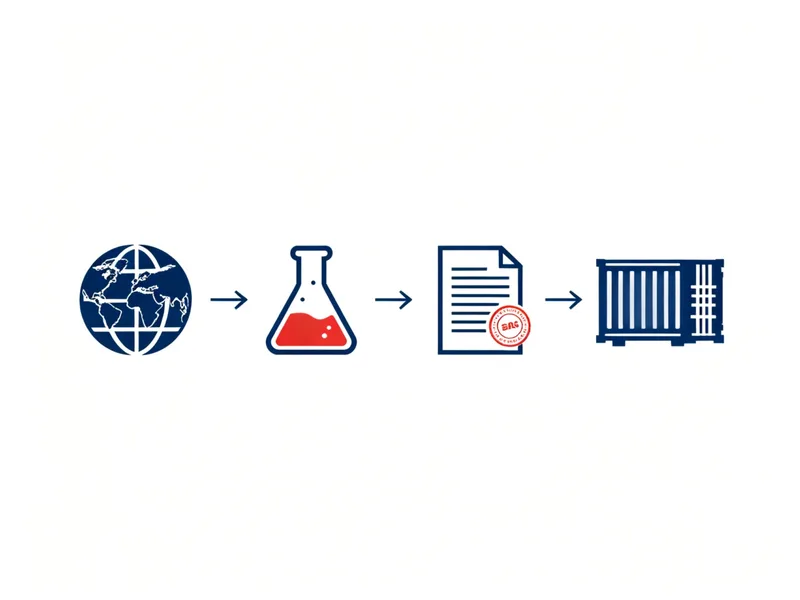
A declaration of conformity is a confirmation form where the applicant is an importer or manufacturer registered in the EAEU. For diamond micron powder this is a lighter procedure than a certificate, but mandatory for lawful supply. Typical steps:
- Classify the product by HS code (7105 10 000 0).
- Identify the applicable EAEU technical regulation.
- Sample selection and testing in an accredited lab.
- Compile the technical dossier (test reports, description, label).
- Register the declaration in the registry via an accredited body.
- Apply the EAC mark on packaging and accompanying documents.
Typical timeline is 1–3 weeks with a ready dossier. The supplier provides specification, particle-size report and certificate of analysis (COA) that form the basis of the declaration.