Diamond micron powder with particle size below 10 μm has enormous specific surface area (up to 10–50 m²/g) and is extremely prone to agglomeration. Even the highest quality powder with perfect particle size distribution will cause scratches and uneven polishing if not properly dispersed. Agglomerates 20–50 μm in size, composed of W1–W3 particles, can leave scratches as if you were using W20 powder.
Why Diamond Powder Agglomerates
Diamond micron powder agglomeration is caused by several forces acting simultaneously:
- Van der Waals forces — the main cause of nano- and micron powder agglomeration. These attractive forces between surface molecules act at 1–10 nm distance and are proportional to contact area. For 1 μm particles, van der Waals energy is 100–1000 times higher than thermal energy (kT), so particles spontaneously stick together.
- Electrostatic forces — when particles rub against each other (especially in dry powder), they accumulate electrostatic charge. Oppositely charged particles attract. In dry powder, electrostatics can be stronger than van der Waals.
- Capillary forces — with even traces of moisture (1–2%), liquid menisci form between particles, creating capillary pressure that pulls particles together. This is the main cause of agglomeration when storing powder in humid environments.
- Binder/impurity bridges — surfactant residues, salts or metal oxides on particle surfaces can form solid "bridges" between particles during drying, creating strong agglomerates that cannot be broken by simple stirring.
Why Agglomerates Are Dangerous
- Scratches — a 30 μm agglomerate composed of W1 particles leaves a 5–10 μm deep scratch, like from W20 powder. Such scratches cannot be removed by subsequent polishing.
- Uneven material removal — agglomerates act as individual large particles, creating local overloads and depressions.
- Reduced effective concentration — up to 30–50% of powder may be bound in agglomerates and not participate in cutting, reducing productivity.
- Filter and channel clogging — agglomerates clog circulation system filters and slurry supply nozzles.
Dispersion Methods
1. Ultrasonic Dispersion
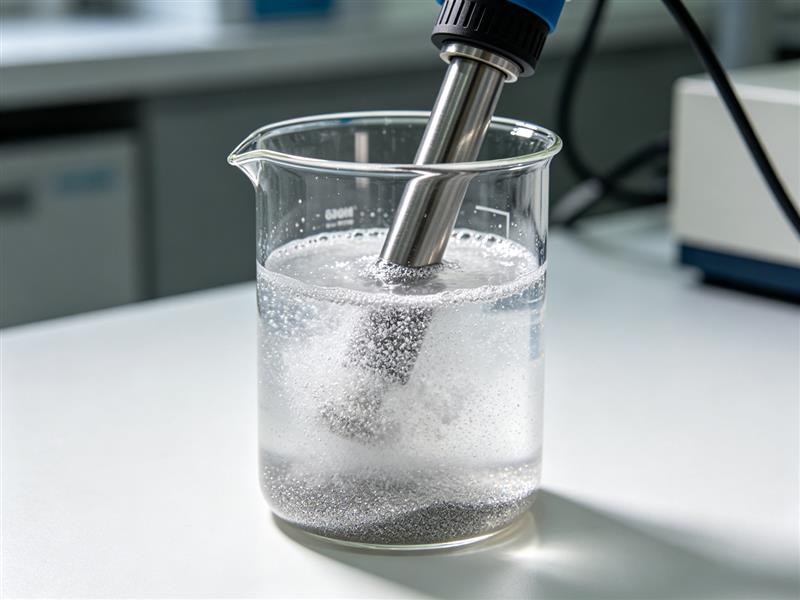
The most common method for laboratory and production slurries. An ultrasonic probe (20–40 kHz, 100–1000 W) creates cavitation bubbles in the liquid that collapse with energy sufficient to break agglomerates.
- Optimal time: 5–15 min for W1–W10, 2–5 min for W20–W40
- Temperature: keep below 40°C (ice bath cooling), otherwise surfactants degrade
- Mistake: too long treatment (>30 min) causes probe erosion and metal contamination (titanium/stainless steel)
2. Bead Mill
For production volumes (from 10 L), bead mill is the most effective method. Slurry is passed through a chamber filled with grinding beads (0.3–1 mm diameter, zirconia or glass), rotating at high speed. Shear forces and bead impacts break even strong agglomerates.
- Advantage: continuous process, reproducible result, suitable for large volumes
- Disadvantage: high equipment cost, bead wear adds impurities (ZrO₂)
3. High Pressure (Homogenizer)
Slurry is passed through a narrow gap at 1000–3000 bar pressure. Sudden pressure drop and high shear rate break agglomerates. This method is especially effective for very fine powders (W0.5–W3) and nanodiamonds.
4. Chemical Dispersion (Surfactants and pH)
Mechanical dispersion breaks agglomerates, but without chemical stabilization, particles will re-agglomerate within minutes or hours. Chemical dispersion creates a repulsive layer on particle surfaces:
- Electrostatic stabilization — adjusting pH so particle surfaces have strong charge (for diamond, optimal pH 9–11, when surface is negatively charged). Like-charged particles repel.
- Steric stabilization — surfactants (polyethylenimine, sodium polyacrylate, sodium lauryl sulfate) adsorb on particle surfaces, creating a 5–20 nm thick steric barrier that prevents particle approach.
- Electrosteric (combined) — the most effective approach: surfactant creates both charge and steric barrier simultaneously.
Step-by-Step Slurry Preparation Protocol
- Water preparation — use deionized water (resistivity ≥ 18 MΩ·cm). Warm to 30–35°C for better surfactant dissolution.
- Surfactant addition — add dispersant (sodium polyacrylate 0.1–0.5 wt% or polyethylenimine 0.05–0.2%). Stir until fully dissolved (2–3 minutes).
- pH adjustment — adjust pH to 9–10 (for diamond) with dilute NaOH or NH₄OH solution. Verify with pH meter.
- Powder pre-wetting — slowly add diamond powder to water under continuous stirring (mechanical stirrer, 300–500 rpm). DO NOT dump powder all at once — it will form lumps. Add gradually over 2–3 minutes.
- Pre-mixing — stir for 5–10 minutes for uniform distribution and wetting of all particles.
- Ultrasonic dispersion — treat with ultrasonic probe: W1–W5 → 10–15 min, W7–W20 → 5–10 min, W28–W40 → 2–5 min. Keep temperature below 40°C.
- Quality control — verify dispersion by one of methods: particle size measurement on laser granulometer (D50 should match specified), optical microscopy (agglomerates visible as dark clusters), or test polishing of reference sample.
- Storage — store slurry in sealed container at room temperature. Before use, always re-treat with ultrasound for 2–3 minutes (particles may re-agglomerate during storage).
Key principle: dispersion is not a one-time action, it's a process. Mechanical dispersion breaks agglomerates, chemical stabilization prevents their reformation. Without both components, the slurry will be unstable. Always verify dispersion quality before use — it takes 5 minutes but saves hours of rework.
Typical Dispersion Mistakes
Mistake 1: slurry concentration too high
New process engineers often make the slurry "thick" — 30–40% solids by weight. In practice, above 10–15% solids, viscosity rises sharply, cavitation does not occur in the ultrasonic bath, and grains re-agglomerate. For W5–W20 micron powder the optimal loading is 3–8% solids; for submicron W0.5–W1 it is 1–3%.
Mistake 2: ignoring slurry pH
Diamond has an isoelectric point around pH 4–6. In neutral water, the surface charge on grains is close to zero, and van der Waals forces easily overcome it. Alkalizing to pH 8–9 (with TEA or KOH solution) creates a negative surface charge, and grains begin to repel each other — this improves dispersion dramatically without any surfactant.
Quick Dispersion Checklist
| Parameter | Recommendation |
|---|---|
| Solids loading | 3–8% (W5–W20), 1–3% (W0.5–W1) |
| pH | 8–9 (alkaline) |
| Ultrasound | 20–40 kHz, 5–15 min |
| Surfactant | Surfactant at 0.5–1% of powder weight |
| Shelf life | Depends on formulation, usually 24–72 h |
Why the Slurry Settles Overnight
If in the morning you see a dense sediment at the bottom and clear liquid on top — this is not "bad powder", but gravitational settling. The settling velocity of a grain follows Stokes' law and is proportional to the square of diameter. For 10 μm grains in water, settling time is a few hours; for submicron (0.5 μm) it is a day or more. The solution is simple: before each use, stir the slurry mechanically for 2–3 minutes or use short ultrasound for 30–60 seconds. Do not add fresh powder directly to an old settled slurry — this guarantees agglomerates.
Another common cause is micro-bubbles of air adhering to the hydrophobic diamond surface. They reduce the effective grain density and cause flotation (floating up). Adding 0.1% isopropanol or ethanol breaks the bubbles and stabilizes the slurry.
Dispersion is not a one-time step but an ongoing concern for the process engineering team. Check it every shift with a drop on a glass slide under a 40× microscope: if agglomerates larger than 5 μm are visible, adjust the process.
Factors of Dispersion Stability
To keep powder from settling and agglomerating in suspension, stability is set by several factors. The key is zeta potential: at values beyond ±30 mV particles electrostatically repel and do not coagulate. It is tuned by surfactant type (anionic or cationic) and pH; for aqueous suspension the optimum is often mildly alkaline (pH 9–10). Solvent and surfactant are chosen for the coating method (dip, spray, stencil). Stability is checked by a simple sedimentation test: a suspension with no visible layering over 24 h is considered workable.