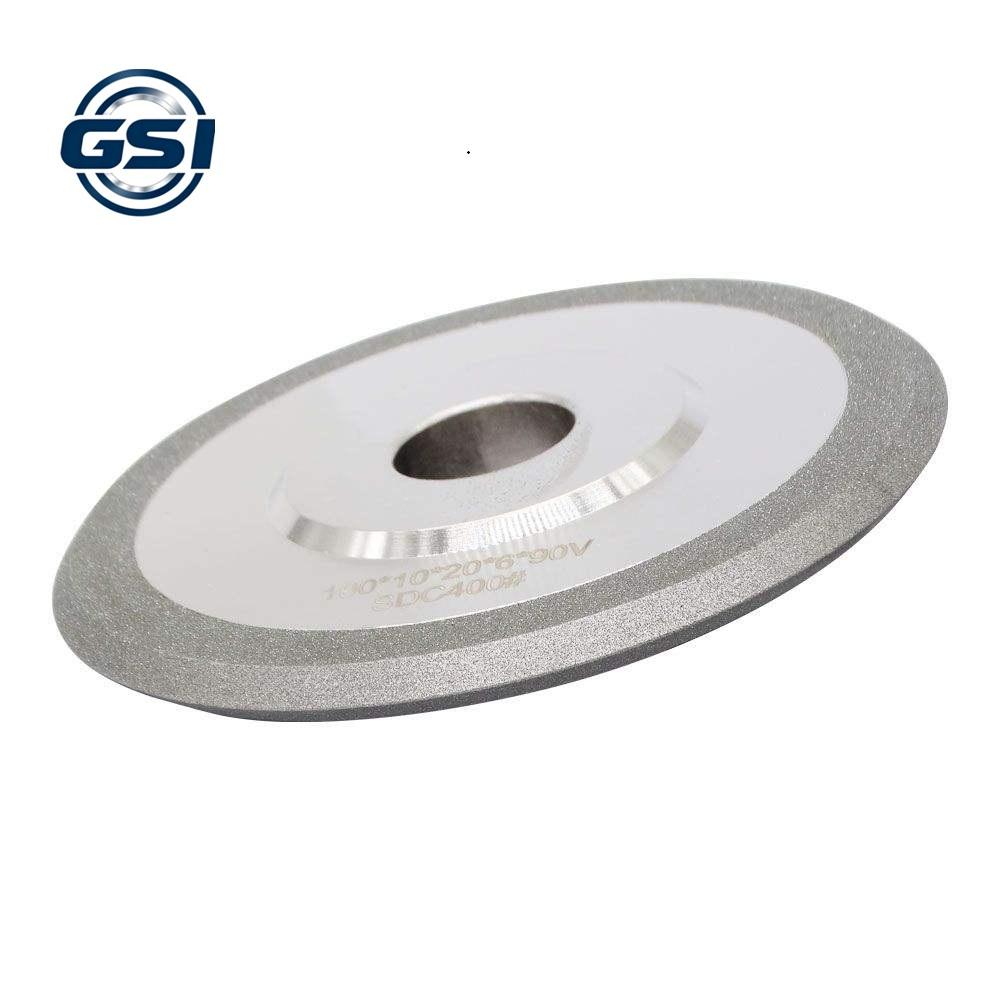
Electroplated diamond tools form a distinct class of equipment, made by holding diamond grains in a layer of electrolytic nickel on a steel shank. Unlike sintered or brazed tools, an electroplated layer retains diamond only mechanically: nickel wraps the grains to about 50–60% of their height. This makes the cutting edge maximally sharp and open —but also critically dependent on the powder's own characteristics. A mistake in grain size, distribution or shape turns into premature pullout, "loading" and a sharp drop in tool life. In this article we break down how to choose the right diamond micron powder for the plating bath, and why a narrow distribution solves 80% of problems.
⚠️ DIAMTECH supplies PCD-grade diamond micron powder (≤20 μm) with narrow distribution and D50/D90 control — exactly the parameters that matter for a stable plating bath. Grit ranges in this article are technical guidelines for different operations, not characteristics of a specific batch.
How an Electroplated Diamond Tool Is Built
The process starts with cleaning and activating the steel shank, then it is immersed in a nickel electrolyte where diamond particles are either suspended or applied in several passes. Nickel deposits on the cathode and gradually "embeds" the grains. The key difference from hot-pressed metal bond is that bath temperature stays at 40–60°C, so thermal load on diamond is minimal —no graphitization and no strength loss. But mechanical retention is modest: grains are held by geometry, not by chemical or covalent bonding. The direct consequence: the more regular the geometry and the narrower the distribution, the more reliably the tool works until first resharpening.
Grain Size: What to Choose for Each Operation
Grain size sets both material removal rate and surface quality. For electroplated tools (burs, stones, files, drills, cut-off wheels), micron powder is chosen primarily by required roughness and workpiece material. The rule is simple: soft material and coarse operation —coarser grain; hard material and fine finish —finer grain.
| Operation | Typical grit | D90 tolerance | Roughness |
|---|---|---|---|
| Rough stock removal | 14–20 μm | ±20% | Ra 0.8–1.6 |
| Medium processing | 7–14 μm | ±15% | Ra 0.4–0.8 |
| Fine finishing | 3–7 μm | ±10% | Ra 0.1–0.4 |
| Precision polishing | 1–3 μm | ±10% | Ra ≤ 0.1 |
For electroplating it is especially important that the batch has no "tail" of coarse grains (D100, D97 values). A single coarse grain in the layer acts as a "bearing": it exits the nickel first, increases radial runout of the bur and ruins the workpiece surface. That is why when ordering micron powder for plating you must request not only D50 but also D97/D100, and check them on receipt.
Size Distribution: Narrow Means Stable
Wide distribution is the most common hidden cause of electroplated tool rejection. When grains of 5 and 20 μm are mixed in the bath, coarse grains exit the nickel earlier and work alone, while fine grains "drown" in the matrix and take no part in cutting. The effective layer becomes non-uniform: overload in some spots, idle in others. A narrow distribution (D90/D10 ratio around 2–3 for micron powder) gives a uniform cutting layer, stable runout and predictable life. That is why electroplaters are willing to pay a premium for a narrow fraction.
Grain Shape and Retention
- Blocky (cubic) — preferred for electroplating: resistant to pullout, gives even wear and uniform load. Optimum for most operations.
- Sharp-edged (crushed) — aggressive cutting edge, but pulls out easier and loads up more on ductile materials (aluminium, brass).
- Spherical (rounded) — minimal bite, used for polishing and avoiding deep scratches; retained worse by nickel, needs higher loading.
Single-Layer vs Double-Layer Bath
There are two main process routes for applying diamond to an electroplated tool. In the single-layer method, grains are sprinkled on a wet surface and embedded in nickel once —giving the most open edge, but the layer cannot be resharpened. In the double-layer method, a coarse layer is applied first (for material removal), then a fine one (for surface quality) —costlier, but yields a combined tool. The choice directly depends on which micron-powder fractions the maker buys: a double-layer tool needs two narrow fractions with clear separation, otherwise the layers "mix".
Batch QC on Receipt
- Request a certificate with D50, D90, D97 (D100) and a distribution histogram.
- Visually check 2–3 samples under a microscope for agglomerates and a coarse-grain "tail".
- Compare D90/D10: for a narrow fraction it should be ≈2–3.
- Check purity (no metallic impurities) so the bath stays clean.
Practical conclusion: an electroplated diamond tool works exactly as well as the powder in its bath is stable. Narrow distribution, no coarse "tail", blocky shape and a certificate with D50/D90/D97 —the four pillars of a quality electroplated tool. Test micron powder on a short trial bath before serial ordering.
Need a narrow micron powder for electroplating?
DIAMTECH supplies PCD micron powder ≤20 μm with D50/D90/D97 control and trial batches from 1 kg. Tell us your operation and target grit —we will match a fraction for your bath.
Request a trial batch