The same diamond micron powder can "show" a different D50 in different labs. The buyer sees a figure on the certificate, gets another in their own lab —and concludes the supplier overstated or understated quality. In reality the gap almost always comes not from deception but from different measurement methods. Laser diffraction, sedimentation, sieves and microscopy answer different questions and give systematically different numbers. Understanding which method shows what is direct savings on rejects and disputes. In this article we break down the four methods for measuring diamond micron powder particle size, their principles, use cases and typical discrepancies.
⚠️ DIAMTECH supplies PCD-grade diamond micron powder (≤20 μm), controlling D50/D90/D97. Data in this article describe general principles and typical inter-method discrepancies; a specific batch may have its own values —always stated on the certificate.
Method 1: Laser Diffraction
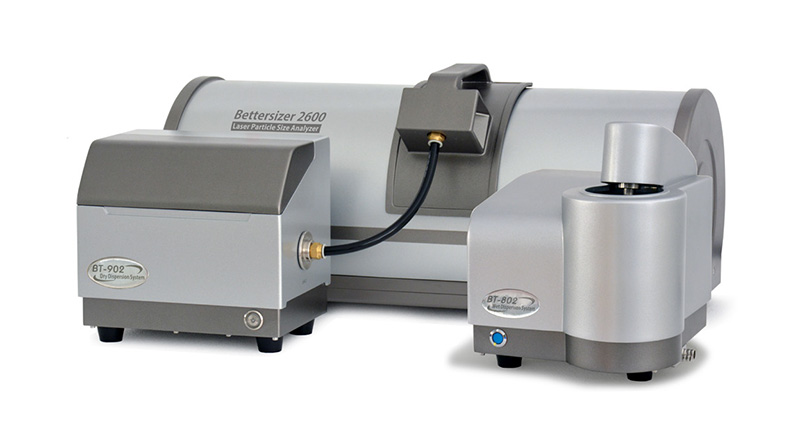
Laser diffraction is the most common industrial method. Powder is dispersed in liquid (or dry flow), a laser passes through the suspension, and the size distribution is calculated from the light scattering pattern. The method is fast, automated and covers a very wide range —from tens of nanometers to millimeters. There is a nuance though: it measures not the geometric size of each particle but the light-scattering equivalent, which depends on shape and refractive index. For non-spherical grains (and diamond micron powder is often sharp-edged), laser diffraction can overstate the fine-particle share. This matters when comparing with microscopy.
Method 2: Sedimentation
Sedimentation analysis is based on Stokes' law: coarse particles settle faster than fine ones. Powder is suspended in liquid, and from the settling rate (usually measured via optical density or pressure at different depths) the distribution is calculated. For narrow micron fractions (1–20 μm), sedimentation gives values closer to the "physical" particle size than laser diffraction, and historically was used to certify diamond micron powders (GOST 9206). Its limits: slowness and sensitivity to agglomeration —if particles clump, they settle as one large grain.
Method 3: Sieve Analysis
Sieve analysis is the most intuitive and the crudest. Powder is sieved through a set of sieves with known openings, and each fraction is weighed. The method is indispensable for coarse fractions (usually from 45 μm and up, where 325-mesh sieves exist), but useless for real micron powder ≤20 μm —the openings of the finest sieves (5–20 μm) clog, require costly micro-sieves, and still cannot give a narrow distribution. For micron diamond, sieves serve only as a coarse check for a "tail" of coarse grains (for example, D100 control through a 20 μm sieve).
Method 4: Microscopy
Microscopy is the only method that shows the true shape and real size of each particle. SEM (scanning electron microscopy) gives images with magnification up to hundreds of thousands, letting you assess both morphology and geometric size. Microscopy is what reveals what neither diffraction nor sedimentation sees: agglomerates, twinned grains, needle-like particles, impurities. The limit is labor: to get a statistically significant distribution you must measure thousands of particles, done by automated image analyzers. In practice microscopy serves as the reference method to validate D50/D90 figures from diffraction.
Why Figures from Different Labs Disagree
| Method | What it measures | Strengths | Limits |
|---|---|---|---|
| Laser diffraction | Light-scattering equivalent | Fast, wide range, automated | Shape- and RI-dependent |
| Sedimentation | Stokes diameter | Close to physical size, GOST 9206 | Slow, agglomeration-sensitive |
| Sieves | Mass by opening ranges | Simple, for coarse fractions | Useless for ≤20 μm |
| Microscopy | Geometric size and shape | Accurate, sees morphology | Labor-intensive, sampling |
A practical rule on receipt: always state in the specification which method must measure D50/D90, and compare apples to apples. If you use laser diffraction and the supplier uses sedimentation per GOST 9206 —expect a systematic difference and fix it in the contract. The typical discrepancy between diffraction and sedimentation for micron diamonds is on the order of 10–30% in D50, and that is normal, not a defect.
Practical conclusion: there is no "right" or "wrong" method —there is the method agreed between buyer and supplier. For powder ≤20 μm, the standard is laser diffraction with microscopy morphology check, and sedimentation as a GOST attestation method. Always require the method on the certificate and check D90/D97, not only D50.
Need micron powder with verified particle size?
DIAMTECH supplies PCD micron powder ≤20 μm with a certificate (laser diffraction + microscopy) and D50/D90/D97 control. Request the report with a trial batch from 1 kg.
Request a trial batch